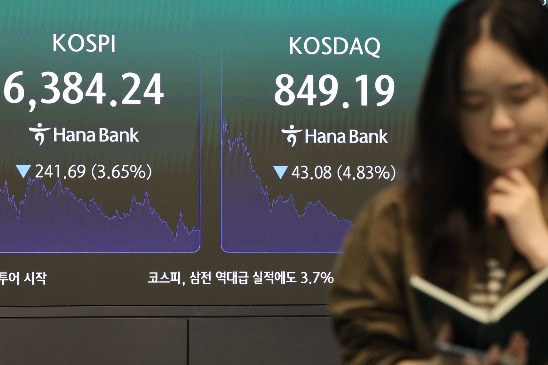
The decline was heavily influenced by a deepening selloff in the semiconductor sector, which constitutes a major portion of the index’s weight. Samsung Electronics, a key heavyweight, closed down 4.39% at 250,500 won (approximately $188), while SK Hynix fell 4.52% to 1.605 million won. These two memory chipmakers, which had previously benefited from the boom in artificial intelligence (AI) infrastructure investment, weakened in tandem, exacerbating downward pressure on the broader market. The simultaneous drop highlights the structural risk inherent in the KOSPI’s heavy reliance on a narrow group of semiconductor leaders.
Market dynamics have shifted significantly over the past few months, characterized by declining turnover and sustained capital outflows. Trading volume on the South Korean stock market has fallen by approximately 70% from its peak in late May. This contraction in activity reflects a broader retreat in retail participation and accelerated capital outflows by foreign investors. The divergence is particularly stark when compared to the first half of the year, when domestic enthusiasm was high. Between January and June, Korean individual investors poured a net 99.17 trillion won into shares on the KOSPI.
In the third quarter, however, a reversal occurred. Individuals sold a net 5.59 trillion won ($4.2 billion) of KOSPI shares during the July-September period. Net purchases of 5.37 trillion won in July and 3.24 trillion won in August were overwhelmed by net sales of 14.2 trillion won in September alone. This domestic selling coincided with a robust increase in demand for U.S. equities. Korean retail investors made net purchases of $7.63 billion, equivalent to roughly 10.15 trillion won, in U.S. stocks during the same three-month period. In September specifically, the heavy selling in Korea mirrored net buying of approximately $1 billion in U.S. stocks.
Analysts attribute this capital migration to several converging factors. While the KOSPI has struggled to regain momentum since falling below the 7,000 mark on July 13, U.S. markets have been pushed to fresh record highs by sustained optimism surrounding the AI sector. Furthermore, currency movements have increased the appeal of dollar-denominated assets. After trading above 1,500 won per dollar in the first half of the year, the Korean won has strengthened to the mid-1,300 range. This appreciation means investors require less home currency to purchase U.S. stocks, effectively lowering the cost of entry for international equities.
“Investment is gravitating toward the AI value chain, where rapid growth offers resilience against high borrowing costs. The relative strength of developed markets over emerging markets, combined with Taiwan’s outperformance of Korea among emerging markets, is further directing money toward U.S. AI-related businesses,” said Kim Jong-min, a senior researcher at Samsung Securities.
The volatile market conditions have prompted urgent responses from South Korean government and central bank officials. On October 12, the Finance Minister stated that the government would implement market stabilization measures when necessary to cope with financial market fluctuations, citing elevated global bond yields as a backdrop for the volatility.
Bank of Korea Governor Shin Hyun-song also addressed the market turmoil, specifically regarding the risks associated with single-stock leveraged exchange-traded funds (ETFs). Shin apologized to the nation, admitting that the central bank had failed to adequately caution the public about the risks of such products. He acknowledged that in late May, he did not fully grasp the extent of the volatility in the South Korean stock market and the memory chip sector. This admission has intensified regulatory scrutiny over leveraged investment products, leading to heightened warnings for retail investors.
Meanwhile, sentiment among professional money managers has turned cautious. A survey of 53 fund managers by The Korea Economic Daily indicated that expectations for the KOSPI over the next three months have been significantly lowered. This reflects a growing preference for U.S. equities and a retreat from the volatile summer rally that had previously driven South Korean markets. With Japanese stock markets closed for a public holiday, the focus in Asia remains squarely on the stability of South Korea’s semiconductor-heavy index and the pace of capital outflows to the United States.