
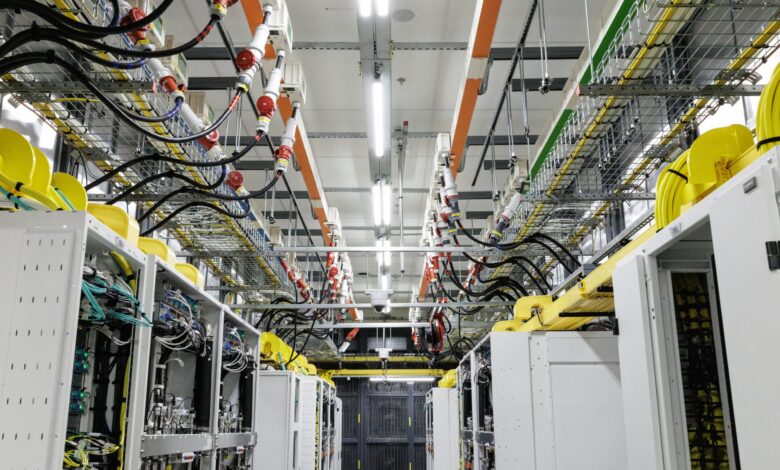
In the United States, roughly 3,000 data centers are currently operating, a number expected to double in the coming years. This expansion has turned the industry into a focal point for both Republican and Democratic voters, particularly as midterm elections approach. The tension is palpable in states like Texas, where the grid must accommodate enormous electricity demands while maintaining reliability. Crosby argues that the industry’s benefits extend far beyond the technology inside the walls. He points to the “blue-collar” economic engine the sector creates. At the Red Oak campus, approximately 600 people work for Compass, while a partner manufacturing facility employs another 300. Since construction began in 2019, thousands of workers have cycled through the project, creating a demand for skilled trades such as carpenters, welders, and electricians. To address this, Compass co-created MEI Pathways, a $12.6 million workforce development program with Texas State Technical College that prepares technicians for the industry. Crosby, a North Texas native, contends that the debate has been dominated by “elitism” that ignores these tangible local jobs and tax revenues.
However, the political calculus is not uniform. In British Columbia, Canada, the issue is equally heated as the province heads into an election on October 24. The federal government recently announced backing for “sovereign AI data centre” clusters led by Telus in Vancouver and Kelowna. While industry leaders support the move, it has sparked protests from groups concerned about the environmental footprint of big tech. The B.C. Green Party has called for a moratorium on new data center construction until stronger regulations are in place. “We have allowed AI tech companies to charge forward and tell us what’s going to be beneficial rather than independently evaluating the cost and benefit to this province,” said Green Leader Emily Lowan.
The core of the dispute in both regions often centers on water and power. In B.C., despite having dozens of hydroelectric dams, persistent drought has left the province reliant on power imports from the United States. Barry Penner, chair of the Energy Futures Institute, warned that the province may not have enough electricity to go around in the next few years. In response to these concerns, the B.C. NDP government has implemented an Energy Statutes Amendment Act, which requires data center proponents to compete for a limited quantity of electricity. This policy prioritizes projects with environmental benefits and First Nations involvement, while imposing higher electricity rates and strict requirements for closed-loop water systems. NDP Leader David Eby stated that the government is requiring developers to “meet certain hurdles,” ensuring they do not waste water and provide local employment.
Telus, the operator of the proposed B.C. clusters, counters that its facilities will run on 98 percent clean hydro power and recycle enough waste energy to heat 150,000 homes. The company claims the centers will use 90 percent less water than traditional data centers. Nevertheless, experts remain cautious. Werner Antweiler, an economics professor at the University of British Columbia, advised a slower approach. “We need to maybe slow down a little bit and make sure we do it right rather than do it wrong and have to pay later,” Antweiler said. Similarly, in Texas, the challenge is not just water but the sheer scale of electricity consumption. The industry’s growth is straining local grids, forcing a reevaluation of how communities can benefit from the new tech boom without compromising existing infrastructure.
The security aspect of these facilities also adds a layer of complexity. Crosby noted that the extensive security measures at his Texas campus are not about secrecy, but about protecting critical infrastructure. “Hacking is real, attacks on infrastructure are real,” he said. If the location of a bank or government operation were known, it could become a target. This necessity for high-level security underscores the strategic importance of these sites, further entangling them with public policy and national security discussions.
As voters in B.C. head to the polls, the outcome may determine the regulatory framework governing the next wave of AI infrastructure. Whether through the B.C. NDP’s competitive electricity model or the market-driven approach seen in Texas, the data center of the future will be shaped as much by political compromise and resource management as by silicon and code. The quiet server rooms of Red Oak and the proposed clusters in Vancouver both represent a shift in how nations view their digital foundations: not as invisible utilities, but as visible, contested, and essential elements of the modern economy.