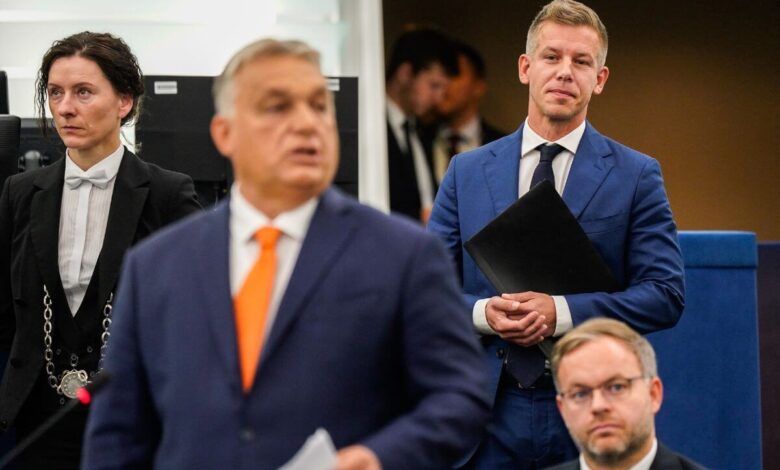
The result was a landslide. Péter Magyar’s Tisza party secured more than two-thirds of the parliamentary seats on 54% of the vote, compared to 37% for Fidesz. With nearly 80% turnout—a record high for the country—Tisza received approximately 3.3 million ballots, the largest single-party vote in Hungarian history. Orbán’s coalition, backed by 2.5 million voters, suffered heavy losses in its heartland constituencies. The political significance of this shift cannot be overstated: for the first time since Hungary’s post-socialist transition in 1989, a change of government of this magnitude has occurred, marking the end of an era widely described by European institutions as a “hybrid regime of electoral autocracy.”
However, the path from election night to a fully restored European relationship is not linear. While the victory is framed domestically as a return to hope and a break from state capture, the policy trajectory of the incoming government suggests a more complex reality for Brussels. Magyar, a former Fidesz official and government minister who entered politics in early 2024, has positioned his party as pro-European, yet his manifesto reveals significant areas of continuity with previous policies.
Tisza’s platform, published in early February, explicitly “chooses Europe” and pledges to rebuild trust with EU and NATO allies. A central pillar of this strategy is the restoration of the rule of law, framed primarily as a mechanism to unlock €18 billion in EU funds currently frozen due to systemic violations. The party has committed to joining the eurozone by 2030. Yet, on the geopolitical issues that have most strained relations between Budapest and Brussels, the new government signals caution rather than a clean break.
On Ukraine, Tisza’s manifesto is notably thin. Magyar has repeatedly stated he would not reverse Hungary’s current policy of non-support for Ukraine’s accelerated accession. While he has expressed an intention to reduce dependence on Russian energy, his proposed timeline for energy independence—by 2035—falls well behind the EU’s target of 2027. Furthermore, Tisza opposes the European Commission’s proposal for the next multiannual financial framework, arguing it disadvantages Hungary, and rejects the EU’s migration and asylum pact. This ambivalence is reflected in the party’s behavior in the European Parliament. An analysis by Eulytix for the European Policy Centre (EPC) shows that while Tisza MEPs are mostly aligned with pro-EU forces, they engage in tactical alignment with Fidesz on politically sensitive issues such as agriculture and migration.
Since the start of the current parliamentary term, Tisza has aligned with the European People’s Party (EPP) in 84.3% of votes, with Renew Europe in 75%, and with the Socialists and Democrats (S&D) in 64%. However, convergence with the European Conservatives and Reformists (ECR) group, which is often critical of EU centralization, occurred in 62% of cases. This voting record suggests that while Tisza is fundamentally pro-European, it is not a monolith that will automatically support all Brussels initiatives, particularly those concerning fiscal contributions and migration policy.
The immediate task for the new government is internal. Magyar has vowed to bring independence to state media and counter corruption, including by joining the European Public Prosecutor’s Office. He has called on the President and other Orbán loyalists in key positions to resign or be removed from office as the new government is established around mid-May. On April 13, he promised term limits for the prime minister to prevent the concentration of power that characterized the previous decade. The challenge lies in dismantling the structures of the previous administration, which remain embedded in the state bureaucracy and judiciary.
For the European Union, the victory offers a strategic opportunity but requires managed expectations. The defeat of Orbán removes a primary source of obstruction to common EU positions on security and foreign policy. However, the new government’s approach to Ukraine and fiscal matters indicates that Hungary will not simply become a compliant junior partner. The relationship will likely be transactional, focused on the mutual interests of fund disbursement and market integration, rather than ideological alignment.
The lessons from this election extend beyond Hungary. For opposition movements in countries such as Georgia and Serbia, where divided oppositions have failed to convert protests into electoral wins, the Hungarian result demonstrates the efficacy of a unified, anti-corruption platform that appeals to a broad base. Yet, the post-election reality remains uncertain. While the democratic transition is underway, the depth of state capture left behind by sixteen years of rule means that institutional reform will be a long-term project. The coming weeks will test whether Magyar can translate electoral mandate into structural change, balancing the domestic demand for accountability with the complex diplomatic negotiations required to re-integrate Hungary fully into the European mainstream.