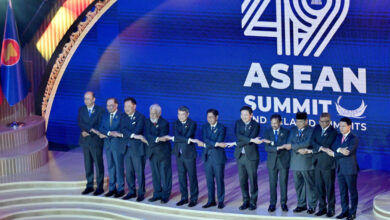
The pact, intended to manage tensions and prevent maritime conflict, has been under negotiation for more than 20 years. In 2023, foreign ministers agreed to finalise the document within three years, setting a deadline for 2026, the year the Philippines holds the ASEAN chairmanship. Department of Foreign Affairs (DFA) Secretary Maria Theresa Lazaro stated on Saturday that 80 percent of the document is finished, though she acknowledged that “salient” points require further resolution. One major point of contention is the geographical scope of the agreement.
Beijing claims jurisdiction over nearly the entire South China Sea, a position invalidated by a 2016 international ruling. Overlapping territorial claims are also held by the Philippines, Vietnam, Malaysia, Brunei, and Indonesia. Philippine officials have indicated a desire for the accord to respect the rights of countries outside the region, noting that half of the world’s merchant ships transit the area.
Diplomatic relations between Manila and Beijing have deteriorated since President Ferdinand Marcos Jr. took office in 2022. Confrontations have included the use of water cannons by the China Coast Guard against Philippine vessels, collisions, and an incident in which a Filipino soldier lost a finger. Recent weeks have seen a sharp exchange of rhetoric. In September, Philippine Defence Secretary Gilberto Teodoro publicly rejected a handwritten note from Beijing that disputed the 2016 ruling. A month later, Chinese Ambassador Jing Quan stated that while China could use force if it chose, it “will not choose force,” a remark President Marcos described as sounding like a threat. This led to a social media exchange between Philippine officials and the Chinese embassy, with some senators calling for the expulsion of the Chinese envoy.
Tensions further escalated in late October when China accused Teodoro of issuing a late invitation to the ASEAN defence ministers’ meeting in Cebu, resulting in China sending only its defence attache instead of its premier. Lucio Pitlo, a past president of the Philippine Association for Chinese Studies, noted that the DFA was concerned about the appearance of China’s limited representation at the host country’s summit.

In an attempt to de-escalate the situation days before the summit, Chinese Foreign Minister Wang Yi spoke by phone with Lazaro. Wang urged the Philippines to “strengthen restraint over the relevant individuals and send a rational and unified voice on its policy toward China.” Lazaro described the conversation as “frank and constructive.” Following the call, the DFA issued a statement calling public commentary by certain officials “regrettable,” emphasizing that public platforms carry institutional responsibilities and that officials must not pursue preferred approaches without regard for the government’s overall policy.
Aries Arugay, a political scientist at the University of the Philippines, stated that the administration faces a difficult balance: a strong document could be accused of being self-serving, while a weak one would portray the government as ineffective. Pitlo noted that the last-ditch diplomatic effort succeeded in ensuring Chinese Premier Li Qiang’s attendance at the summit. However, both analysts believe that broader economic issues, including trade protectionism and supply chain disruptions, will dominate the agenda, leaving the code of conduct negotiations unfinished. The next expected step is for leaders to address these high-priority economic concerns while leaving the maritime code for further negotiation.