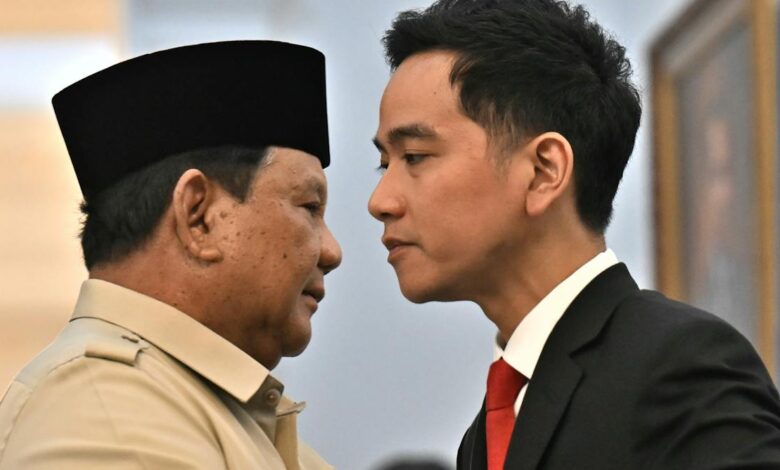
The resignation was the culmination of a legal crisis that began with a Supreme Court ruling last month. The court annulled Gibran’s high school equivalency certificate, a document he had used to qualify for the 2024 vice presidential election. In its determination, the Supreme Court stated that no evidence was found to show Gibran possessed a foreign diploma or certificate that could serve as the basis for such equivalency. Following a separate Constitutional Court ruling in October that annulled his foreign secondary education qualification, the legal basis for his eligibility to hold office was fundamentally undermined. The day before his resignation, 120 lawmakers from all eight parliamentary factions had backed a motion to initiate the impeachment process. Upon receiving the resignation, Prabowo accepted it with a “heavy heart,” praising Gibran for acting “for the benefit of the nation, the state, and the people of Indonesia.”
Politically, Gibran’s exit marks a significant realignment in Indonesia’s power structure. His departure leaves Prabowo without a rival power center within the executive branch, at least until a replacement is elected. More critically, it weakens the political network of former President Joko “Jokowi” Widodo, whose influence was instrumental in bringing Prabowo to power in 2024. With seven of the eight parties in parliament backing Prabowo’s coalition, the president now has greater room to concentrate political and state resources. The Prabowo–Gibran partnership, which underscored the pragmatism of coalition politics, was never built on shared political interests. Once Prabowo assumed office, the two camps began competing for control over bureaucratic positions and state resources. Gibran’s frequent public appearances and distribution of aid, reminiscent of Jokowi’s populist style, had raised speculation that he was positioning himself for the 2029 election, but without a party of his own, his leverage remained limited.
Prabowo’s efforts to centralize authority extend beyond the immediate rivalry with the Jokowi camp. His administration has pursued flagship programs such as the Free Nutritious Meals (MBG) initiative, Red and White Village Cooperatives, and People’s Schools. These programs require substantial funding and coordination from the central government, expanding the state’s presence in local communities. A notable feature of these initiatives is the growing involvement of the Indonesian Military (TNI). Military personnel have been deployed to support MBG kitchens, accelerate the construction of village cooperatives, and instill discipline among students. This blurring of boundaries between civilian administration and military responsibilities potentially strengthens the president’s reach into everyday governance.
Fiscal and economic instruments have also been adjusted to favor central control. The creation of Danantara, a body that consolidates Indonesia’s state-owned enterprise assets, has further eroded the influence previously held by Jokowi, who relied heavily on state-owned enterprises for infrastructure development. According to the International Monetary Fund’s 2025 report, Danantara reports directly to the president, along with a new state-owned enterprise regulatory body. This structure grants the administration considerable influence over state capital and investment decisions. Concurrently, the central government’s cuts to regional fiscal transfers have placed local administrations under pressure. Eighteen governors from the Association of Indonesian Provincial Governments (APPSI) recently protested to the finance minister against these reductions, highlighting the tension between central consolidation and regional autonomy.

These developments occur against a backdrop of public discontent. In recent weeks, thousands of protesters have taken to the streets to voice concerns over economic hardship, corruption, perceived authoritarianism, and the government’s handling of devastating wildfires that produced a toxic haze. The resignation also coincided with the arrest of the former head of the national police and three senior officers on charges of tapping the president’s phone, adding another layer of institutional turmoil. Former President Jokowi, speaking from his hometown in Solo, stated that he had reminded his son that political positions are temporary and that he still supported Prabowo’s leadership. Gibran, in turn, defended his credentials to parliamentary leaders, noting that if he did not have a high school diploma, he would not have been able to enter university.
Analysts view the resignation as a stage in the redistribution of power within Indonesia’s oligarchy. Political sociologists Vedi Hadiz and Richard Robison have long observed that Indonesia’s political competition is a struggle among rival elites for state power and economic resources. Jeffrey Winters, in his book *Oligarchy*, argues that concentrated wealth enables elites to protect and extend their political power. From this perspective, Gibran’s defeat is not merely personal but structural, representing a shift toward greater centralization under Prabowo. Khairul Fahmi, executive director of the Institute for Security and Strategic Studies, noted that while the resignation represents a significant political realignment, it does not necessarily threaten government stability, arguing that Jokowi retains political influence. However, the New York Times framed the departure as injecting new political uncertainty into Southeast Asia’s largest economy.
Under Indonesian law, the path forward is procedurally defined. The People’s Consultative Assembly will elect a replacement vice president from two candidates nominated by the president within 60 days. Until that election occurs, the office remains vacant. Additionally, House leaders must establish a special committee to examine whether Gibran violated the constitution by serving despite allegedly failing to meet election requirements. If lawmakers find sufficient basis, they must ask the Constitutional Court to rule on whether a constitutional violation occurred. Gibran had requested the chance to challenge the ruling and prove the legitimacy of his education, a request described by State Secretariat Prasetyo Hadi. As the assembly prepares to nominate candidates, the immediate question shifts from the legitimacy of the former vice president to the identity of his successor and the extent to which the new appointee will align with Prabowo’s centralized vision of governance.