The entry of Eritrean forces into northern Ethiopia has been corroborated by multiple accounts, though independent verification remains challenging. Ermiyas Ababu, a commander of the Tigray Peace Force based in Mekelle and allied with the Ethiopian government, stated that Eritrean personnel entered Adigrat on Tuesday and Idaga Hamus on Wednesday. He reported that Eritrean military officers were conducting surveillance in Idaga Hamus, citing intelligence from his own personnel in the area. Separately, the conflict monitoring group ACLED reported that Eritrean troops crossed the border at Zelambesa on Wednesday and were targeted by Ethiopian military drones at Guada as they moved toward Idaga Hamus. While the specific details of the drone strikes and the exact routes of movement remain unverified by independent journalists, the convergence of local commander reports and monitoring group data paints a picture of active Eritrean military engagement within Ethiopian territory.
Asmara has firmly rejected these allegations. Eritrean Information Minister Yemane Gebremeskel accused Ethiopia of fabricating a “fallacious narrative of self-defense” to justify military action against Eritrea. He claimed the allegations were a pretext for further war, although he did not specifically address the reports of troop movements or drone strikes. The diplomatic rupture occurred last week when Ethiopia expelled ten Eritrean diplomats and closed its embassy in Asmara, a move Eritrea responded to by severing all diplomatic ties. Ethiopia’s Foreign Ministry stated on Monday that it remains committed to dialogue and peaceful engagement with its neighbors, yet the military reality on the ground suggests a different trajectory.
The military incursion is part of a wider conflict that reignited on September 23, when fighting broke out between the Tigray People’s Liberation Front (TPLF) and Ethiopian federal forces. This resurgence has sparked fears of a return to the devastating civil war of 2020-2022, which resulted in widespread displacement and humanitarian crisis. The immediate military objective for the Ethiopian government appears to be the containment of the TPLF, which it accuses of receiving backing from Eritrea. Eritrea has consistently denied supporting the TPLF, maintaining its distance from the internal Ethiopian dispute, but the physical presence of its troops in Tigray towns complicates this diplomatic stance.
Strategic considerations play a central role in this escalation. Ethiopian Prime Minister Abiy Ahmed reiterated on Monday that his landlocked country must have access to the Red Sea. Ethiopia lost its coastline when Eritrea became independent in 1993, a loss that has long been a source of geopolitical tension between the two states. The current conflict is not merely about quelling a regional rebellion but is also entangled with historical grievances over territory and maritime access. The entry of Eritrean forces into Adigrat and Idaga Hamus, both key logistical hubs in the Tigray region, could disrupt supply lines and alter the balance of forces in the theater.
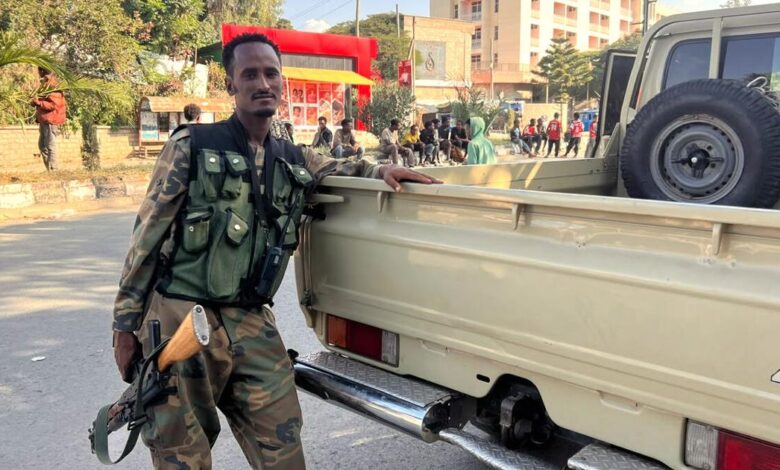
On the ground, the human cost of the renewed conflict is becoming apparent. Residents of Shire, a town in the Tigray region, reported the withdrawal of opposition alliance forces and the closure of local shops, indicating a disruption to normal life. In the regional capital of Mekelle, the Tigray Peace Force imposed a nighttime curfew, a measure typically employed to maintain order during periods of heightened security risk. The presence of military vehicles and armed personnel in civilian areas has heightened anxiety among local populations, who find themselves caught between federal forces, opposition militias, and now foreign troops.
The situation remains fluid and opaque. While the deployment of Eritrean troops is documented by local commanders and monitoring groups, the full extent of their involvement and the scale of their forces remain unclear. The Ethiopian government’s accusation that Eritrea is backing the TPLF is a serious charge that, if true, would implicate a sovereign neighbor in an internal conflict, potentially drawing in other regional actors. The use of drones by Ethiopian forces against Eritrean troops, if confirmed, represents a direct military confrontation between the two nations, a stark contrast to their historical cooperation in the early 2000s.
As the Tigray Peace Force consolidates its position in Mekelle and federal forces continue operations against the TPLF, the entry of Eritrean soldiers into northern towns marks a critical juncture. The next confirmed development will likely hinge on whether these troops remain in a surveillance capacity or engage directly in combat alongside the TPLF. For now, the sight of off-white uniforms in Adigrat serves as a stark reminder that the conflict has crossed a border, threatening to unravel the fragile stability of the Horn of Africa.