
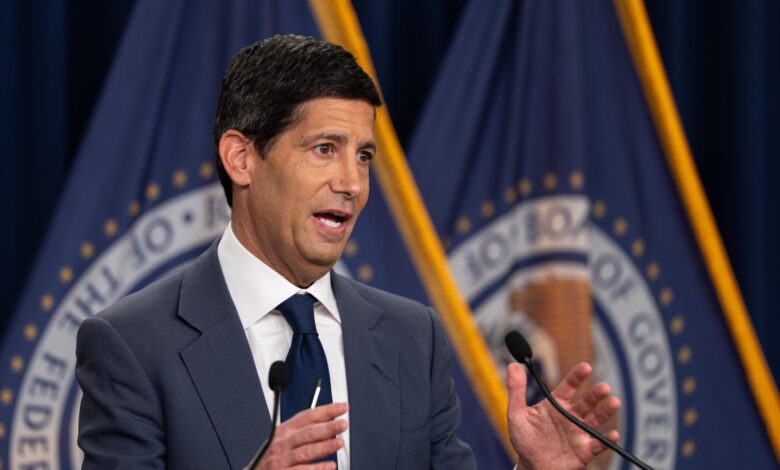
For policymakers, the answer is becoming increasingly complex. Fed Chair Kevin Warsh addressed this directly at a news conference, pushing back against a growing narrative that higher rates would have little effect on AI investment due to the exceptionally high returns investors expect. Warsh rejected the idea that expectations of unusually high returns make financing costs irrelevant.
“With respect to the new technology and this investment surge, do interest rates matter?” Warsh said. “I believe they do, and I don’t believe that they’re somehow divorced from the rest of the economy. Interest rates get in the cracks. Interest rates affect directly, or indirectly, almost everything.”
The significance of this stance is evident in the current data landscape. On Thursday, the Commerce Department released the Federal Reserve’s preferred inflation gauge, the Personal Consumption Expenditures (PCE) index, alongside the advance estimate for third-quarter Gross Domestic Product (GDP). The data confirmed that inflation remained elevated while growth accelerated more than expected.

In September, the headline PCE index rose 0.5% on a monthly basis and was up 3.6% from a year ago. Both figures were in line with expectations of economists polled by LSEG, but they marked a tick upward from August, when headline PCE stood at 3.4%. Core PCE, which excludes volatile food and energy prices and is viewed by policymakers as a better indicator of underlying inflation trends, rose 0.3% monthly and 3.1% year over year. This represents an increase from the 3.0% reading in August. Goods prices increased 3.9% year over year, while services prices rose 3.5%.
Simultaneously, the Bureau of Economic Analysis estimated that third-quarter GDP grew 3.4%, surpassing the 3.2% forecast of polled economists. This strong growth, combined with persistent price pressures, creates a difficult calculus for the Fed. While the central bank held rates steady this week, with two dissenting votes recorded on the Federal Open Market Committee, the strength of the data could make waiting for a decision harder, particularly as the December meeting approaches.
Warsh’s comments suggest that the Fed is closely monitoring how monetary policy interacts with the current investment cycle. He noted that while higher rates may not stop companies from investing in AI, they can influence which projects attract financing, how much capital they receive, and what returns investors demand. Warsh pointed to widening credit spreads for some assets as evidence that investors are becoming more selective. In credit markets, this could mean a growing divide between borrowers with credible paths to cash flow and those whose projects depend on more optimistic assumptions about future demand and profitability.
This distinction matters as companies commit substantial capital to AI-related projects, including data centers and computing infrastructure. Even when the long-term opportunity remains attractive, higher financing costs can weaken project economics and make investors more sensitive to execution risks. However, Warsh cautioned against attributing the economy’s strength to technology alone. He observed that while “high-tech investment” is leading the acceleration, spending is strengthening elsewhere, suggesting that capital spending is broadening beyond the tech sector.

This broadening resilience complicates the Fed’s task in several ways. Strong growth gives policymakers room to keep rates elevated while they assess inflation, but sustained investment and demand could also make price pressures harder to contain. For households, the impact is visible in the personal savings rate, which fell to 3.8% of disposable personal income in September, down from 4% in August. This decline continues a two-year trend from a peak of 6.2% in April 2025 and 5.6% in January 2026, suggesting that consumers are drawing down buffers as they face ongoing price pressures.
The market’s response to the Fed’s decision and the subsequent data release has been mixed. Investors are left to parse whether the current inflationary trend is a temporary blip or a sign that the neutral rate of interest may be higher than previously thought. The Fed’s decision to hold rates steady, despite the upward tick in inflation, signals a preference for patience over immediate tightening, but the gap between the 3.6% headline inflation rate and the 2% target remains significant.
As the economy continues to expand at a strong pace, the focus now shifts to whether the AI-driven investment boom can sustain growth without generating excessive heat in the broader price environment. The next critical data releases will determine if the Fed feels compelled to act sooner than anticipated, particularly if the trend of rising core PCE and accelerating GDP persists into the final quarter of the year. For now, the central bank is watching closely, balancing the risks of over-tightening against the dangers of letting inflation become entrenched.





One Comment