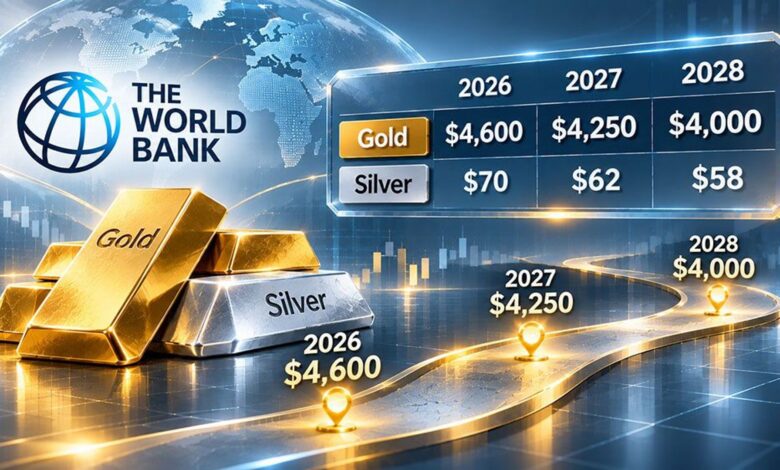
While the World Bank anticipates prices remaining well above historical averages due to geopolitical uncertainty and portfolio diversification, the World Gold Council (WGC) has lowered its full-year 2026 forecast for gold investment demand to 200 metric tons, down from a previous estimate of 400 metric tons. The WGC attributed this reduction to weaker demand for gold bars and coins during the second half of 2026, noting that bar and coin demand fell 19% in the third quarter as investors held back amid price uncertainty.
Market conditions have recently challenged bullish sentiment. Gold futures for January 2027 deliveries fell 1.4% on Tuesday to $3,929.80 per ounce, while silver contracts expiring in January 2027 dropped 3.8% to $49.20 per ounce. The World Bank noted that gold prices fell 5% in the third quarter, with selling pressure continuing into October. The bank cited rising government bond yields, expectations of tighter monetary policy, and a stronger U.S. dollar as key factors weighing on investor sentiment. The Federal Reserve’s September interest rate increase, along with similar moves by other major central banks, has created headwinds for non-yielding assets.
Silver faces steeper correction pressure than gold. The World Bank forecasts silver prices to average $70 an ounce in 2026, a nearly 76% annual gain, before falling more than 11% to $62 in 2027 and another 6.5% to $58 in 2028. The bank’s broader precious metals price index is expected to rise nearly 40% this year before declining 8.3% in 2027 and another 6% in 2028. Despite these projected corrections, prices are expected to remain more than three times their average levels between 2015 and 2019.
Analysts are monitoring key technical levels and macroeconomic events. KCM Trade chief market analyst Tim Waterer stated that a convincing move above $4,000 per ounce would signal improving momentum for gold. Conversely, Ole Hansen of Saxo Bank noted renewed selling near $3,970 an ounce, a former support level that has turned into resistance. Hansen observed that technical and momentum-driven selling continues to outweigh longer-term investor demand. Market attention has turned to U.S. midterm elections, global equities, and Middle East developments, including reports of U.S. strikes on Iran’s Qeshm Island, which contributed to a rebound in oil prices.
Underlying fundamentals for gold remain relatively healthy, according to the World Bank. Investment demand and central bank purchases accounted for roughly half of global gold demand during the first six months of 2026. Although both sources are expected to moderate over the next two years, central bank purchases have started to increase again after slowing earlier in the year. In contrast, jewelry demand has declined sharply since 2023 and is expected to remain weak as elevated prices discourage buyers.