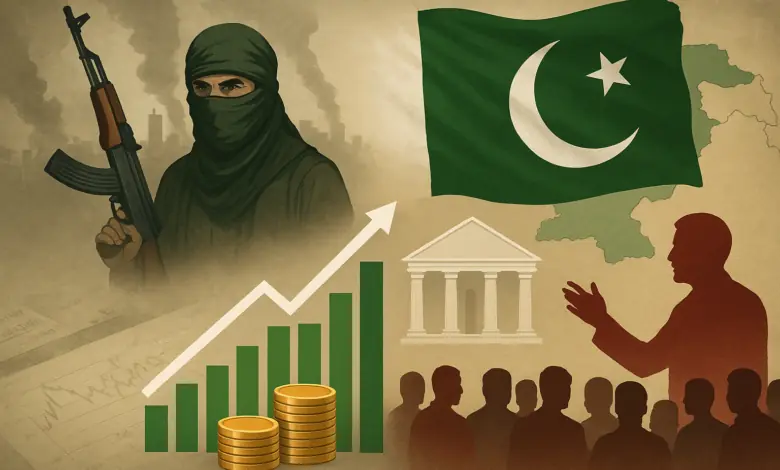
The primary obstacle to Pakistan’s economic trajectory remains the persistent volatility in its western and southwestern borders. In July 2025, militant violence saw a slight but concerning uptick, with 82 reported attacks resulting in 101 fatalities and 150 injuries. The distribution of this violence was heavily concentrated, with Khyber Pakhtunkhwa (KP) and Balochistan accounting for 99% of all incidents. While the erstwhile Federally Administered Tribal Areas (FATA) experienced a 35% decline in violence, KP’s mainland and Balochistan saw notable increases, with attacks and casualties rising by 33% and 40% respectively. This geographic shift in instability directly impacts the regions where significant infrastructure and resource projects are located, creating a risk premium that complicates both domestic investment and the security of supply chains.
The economic implications of this security posture are further complicated by the transnational nature of the threats. The presence of Tehrik-e-Taliban Pakistan (TTP) sympathizers in Bangladesh, evidenced by arrests of militants with links to TTP and the Kuki-Chin National Front (KNF), signals an expansion of jihadist networks across South Asia. For Islamabad, the central security demand remains that Afghan territory not be used to facilitate terrorism inside Pakistan. Yet, as noted by Lt. Gen. Ahmed Sharif Chaudhry, Director General of Inter-Services Public Relations, the dispute is with the Taliban authorities in Kabul, whom he described as a “non-inclusive, non-representative regime.” This diplomatic friction creates uncertainty for investors, as the potential for cross-border conflict remains a latent risk to regional trade routes and energy corridors.
Domestically, political instability further clouds the economic outlook. The imprisonment of Imran Khan and the subsequent legal convictions of senior Pakistan Tehreek-e-Insaf (PTI) leaders have eroded the party’s organizational strength, leading to internal discord. The formation of the Tehreek Tahaffuz Aain-e-Pakistan (TTAP) alliance, which calls for judicial accountability and a new charter of democracy, has failed to generate sufficient grassroots mobilization to challenge the federal government’s control. This political impasse is exacerbated by contentious policy moves, such as the restructuring of the Frontier Constabulary into a Federal Constabulary via presidential ordinance. This move, which bypassed parliamentary oversight, drew criticism for undermining provincial autonomy under the 18th Amendment, fostering a sense of federal encroachment that strains center-periphery relations and potentially disrupts local economic governance.
Despite these internal and security challenges, Pakistan has pursued an active foreign policy to bolster its economic standing. Relations with the United States have improved through high-level military engagement and trade cooperation, although tensions persist over the designation of groups viewed by Pakistan as Indian-aligned. Simultaneously, the deepening strategic partnership with China continues to provide critical financial support. The enactment of the Virtual Assets Ordinance in July 2025 represented a specific step toward regulating digital finance, aiming to attract foreign investment in crypto-assets and integrate Pakistan into the broader global digital economy. However, structural challenges such as poverty, climate risk, and fiscal strain remain unresolved, limiting the immediate impact of these diplomatic and regulatory advancements.
The most significant diplomatic development affecting Pakistan’s economic environment, however, stems from its relationship with India. Following the Pahalgam terror attack and India’s subsequent Operation Sindoor, the two nations engaged in military exchanges until a ceasefire was reached in May 2025. The recent removal of security perimeters by both nations signals a move toward de-escalation. This diplomatic softening coincides with a notable statement by US Ambassador Sergio Gor, who, during a visit to Srinagar, explicitly acknowledged Jammu and Kashmir as an “important part of India.” This recognition, coming from the first US envoy to visit the region in six years, marked a shift in Washington’s stance, triggering a defensive reaction from Pakistan, which lodged a strong demarche alleging the remarks were “factually incorrect.”
For Pakistan, the economic implications of this diplomatic realignment are profound. A stable border with India is a prerequisite for regional trade integration and reduced military expenditure, which could free up fiscal resources for development. However, the security environment within Pakistan remains fragile. The federal-provincial friction over counterterrorism strategy, particularly in KP’s tribal belt where protests have been sparked by civilian casualties and fears of displacement, suggests that the government’s approach to security is not without local political cost. These internal resistances, combined with the transnational reach of militant groups, mean that the economic gains from diplomatic normalization may be offset by ongoing security costs and instability.
Looking ahead, the next critical test for Pakistan’s economy will be its ability to translate diplomatic openings into tangible security improvements that benefit investors and consumers. The sustainability of the current economic momentum depends on whether the government can address the structural fiscal strain while managing the volatile security situation in KP and Balochistan. The removal of security barricades in New Delhi is a positive signal, but without a corresponding reduction in internal militant violence and a resolution of the political disputes over provincial autonomy, the economic benefits of regional peace may remain elusive. The coming months will likely be defined by the extent to which Pakistan can leverage its improved standing with the US and China to foster a more secure and predictable environment for economic activity, a task that requires navigating a complex web of internal political, security, and diplomatic challenges.