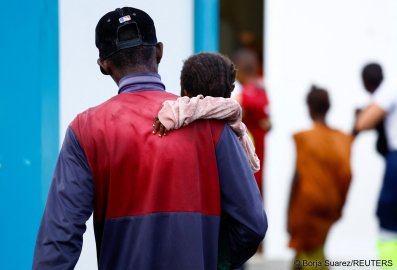
On November 10, Spain’s Interministerial Commission on Immigration declared a migration emergency in the Canary Islands. The decision follows a dramatic acceleration in arrivals that has placed exceptional demands on the archipelago, particularly on El Hierro, the smallest of the main islands. According to official figures cited by the Spanish news agency EFE, 5,857 people reached the Canary Islands in 57 boats between November 1 and 5 pm on Monday. When counting from October 1, when daily rescues resumed after months of relative calm, 12,056 people arrived in six weeks. This volume is more than three times the 3,708 arrivals recorded during the first half of the year.
The concentration of arrivals on El Hierro has created a acute humanitarian and administrative challenge. The island has a resident population of roughly 11,400 to 12,000 people, yet regional authorities reported that 4,587 people arrived there between November 1 and 6, with 35 of the 49 boats in that period reaching the island. By November 10, Canary Islands President Fernando Clavijo stated that around 7,500 people had arrived on El Hierro in the first ten days of the month. Alpidio Armas, head of the governing council for El Hierro, told Spanish television that the sharp increase had led the local administration to declare a social emergency on November 6, estimating that more than 2,000 people remained on the island at that time.
The physical limitations of El Hierro have made the situation particularly critical. The island possesses only about 30 hospital beds, and local officials state that the capacity to refer patients to the larger island of Tenerife has been exhausted. The strain on public resources has necessitated significant reallocation of services. Medical teams and buses have been redeployed from other islands to support the response, and Clavijo noted that local services are under severe pressure. The economic impact is also becoming evident; the diving sector in La Restinga, a key pillar of the local economy alongside fishing and tourism, has reportedly contracted from 11 centers to four, with knock-on effects for hospitality and other businesses.
Madrid’s response includes a commitment of 15.18 million euros to create additional places in state-run reception centers and to fund transfers between the islands and mainland Spain. An additional 1 million euros has been allocated to the Red Cross for initial assistance and medical care in El Hierro. The central government also announced it would reinforce rescue capacity by deploying the Guardamar Caliope, meaning three of Spain’s five operational Guardamar vessels would be assigned to the Canary Islands. Furthermore, the government said it would increase medical and police personnel, accelerate administrative procedures, and transfer unaccompanied minors to other parts of Spain.
Despite these measures, regional leaders argue the response has come too late and is insufficient to address the scale of the crisis. Clavijo welcomed the financial commitments but emphasized that the situation remains “absolutely unsustainable.” He is seeking a comprehensive contingency plan that includes additional security personnel, greater Maritime Rescue capacity, Red Cross healthcare coverage at La Restinga and the Temporary Reception Center for Foreigners (CATE) in San Andres, and compensation for El Hierro residents and businesses affected by the disruption. The Canary Islands government is simultaneously seeking a stronger response from the European Union, with the European Commission stating it is closely monitoring the situation.

The surge in arrivals contrasts with the broader trend of declining crossings in the region. In 2024, record numbers of more than 46,000 migrants arrived in the Canaries. However, stricter surveillance and greater cooperation with countries of origin and transit led to a sharp drop, with only 13,327 irregular migrants arriving by sea between January and October of this year, a 5.5 percent decrease compared to the same period last year. Recent patrols off Senegal, Mauritania, and Morocco have pushed departure points further south, involving The Gambia, Guinea-Bissau, and Guinea, resulting in longer and more dangerous crossings. The Atlantic route remains one of the world’s deadliest migration passages; in recent weeks, at least nine migrants have died off the islands, and survivor accounts cited by AFP indicate five others died during a recent voyage. Senegalese police reported intercepting 142 migrants, including women and young children, off Dakar on Saturday.
As the November figures continue to climb, the focus remains on El Hierro, where the gap between the number of arrivals and the island’s limited infrastructure defines the current geopolitical and humanitarian challenge. The next development will hinge on the implementation of Madrid’s emergency measures and the extent of EU support, while local authorities in La Restinga continue to navigate the immediate practical impacts on their community and economy.