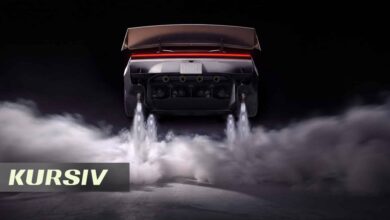
The central innovation of the new Roadster is its “cold gas booster” system, which utilizes ten nozzles of compressed air supported by an onboard air tank that the vehicle can replenish. During the demonstration, this system allowed the car to drive up a vertical ramp, stop inverted, and then launch off a ledge to perform a barrel roll before landing safely. In another sequence, the vehicle completed a side flip from a standstill. These demonstrations highlight the system’s ability to generate significant downforce and thrust, a capability Tesla claims will contribute to on-road performance, drawing technical parallels to the McMurtry Spirling track car.
Performance figures presented during the event show the prototype achieving a 0-60 mph time of 0.81 seconds. While the original 2017 concept promised a 1.9-second 0-60 mph time, the new prototype exceeds this benchmark, with CEO Elon Musk describing the acceleration as “the least interesting part” of the vehicle. Musk indicated a top speed goal of “Mach .5, maybe a little higher,” which equates to approximately 383 mph, though only a claimed top speed over 230 mph was formally cited in the presentation materials. Specific details regarding horsepower, range, and final battery capacity were not disclosed, as Tesla requested redactions from early media access reports to protect exact specifications.
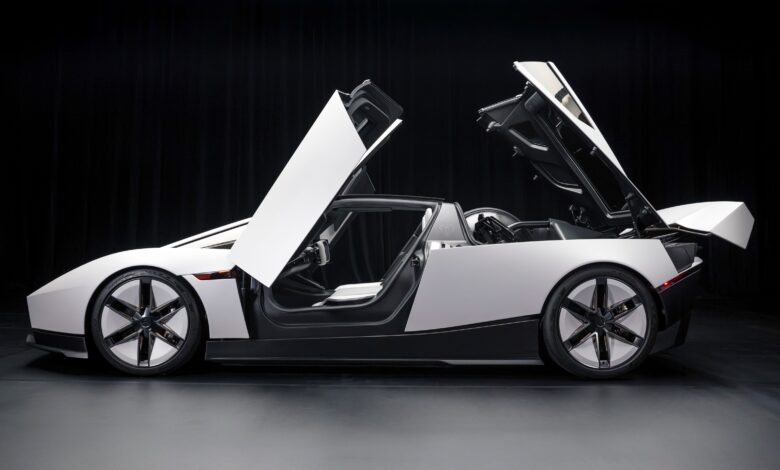
The vehicle’s design has been radically altered from the rounded aesthetic of the 2017 concept to an angular, wedge shape reminiscent of the Cybertruck and Cybercab. This shift aligns with Tesla’s recent design language but also evokes the wedge-shaped supercars of the 1980s. The car is described by Tesla Chief Designer Franz von Holzhausen as a “prototype with production intent,” meaning it is further along than a concept but still undergoing final decision-making processes.
Tesla’s website currently lists two distinct “augments” or option packages for the Roadster. The first, labeled “Thrust,” is described as a limited-release, two-seat model equipped with rear-mounted cold-gas thrusters used in the acceleration demonstrations. The second, labeled “Rocket,” is designated as “invite only” and features the full suite of thrusters used for the aerial stunts. Crucially, the website states that the “Rocket” variant is “not approved for public road use,” indicating that the most extreme performance capabilities are restricted to closed-course or private demonstrations rather than legal street driving.
Production timelines remain a point of contention. Musk stated on stage that Tesla is targeting the “start of production in 2028,” adding the word “actually” to the statement. This follows a history of missed deadlines, with the original production target set for 2020, subsequently sliding through 2021, 2022, and 2023. The reveal event itself was pushed from October 1 to October 15 due to severe weather forecasts. Pricing for the base model and the various augments was not announced, leaving the commercial viability of the vehicle uncertain at this stage.
The vehicle represents a unique position in Tesla’s portfolio. Musk stated that the Roadster will be “long term, the only manually-driven car that Tesla makes,” signaling a departure from the company’s broader focus on autonomous driving capabilities. While the aerial stunts may be viewed by some as promotional gimmicks, the underlying use of fan suction and cold-gas thrusters for downforce and acceleration represents a distinct technical approach to high-performance electric vehicles. The collaboration with SpaceX, while not fully detailed in terms of proprietary tech transfer, is evident in the shared manufacturing and development environment in Texas and the application of aerospace-inspired propulsion principles to a road vehicle.
As of now, the base model Roadster has not yet been confirmed as a finalized production model, and specific battery specifications remain under wraps. The next confirmed milestone is the continuation of the prototype testing phase leading up to the 2028 production start. Until then, the “Rocket” variant remains a demonstration tool, while the “Thrust” variant offers a glimpse into what may become the highest-performance street-legal vehicle in Tesla’s lineup.