
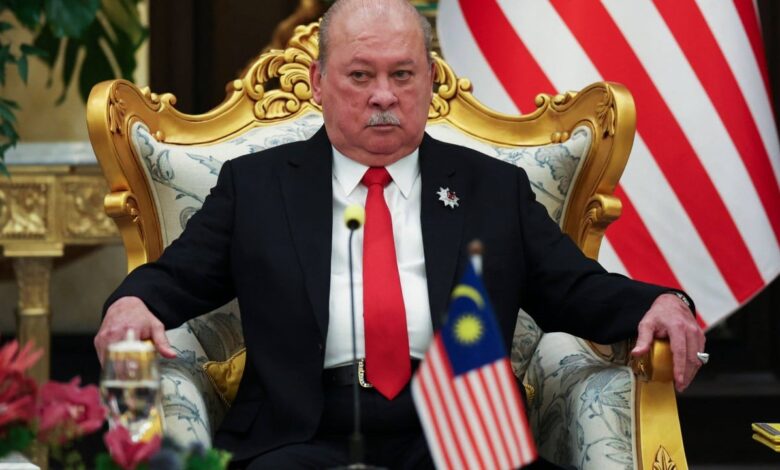
The central legal development revolves around the enforcement of a specific royal command. In the Malaysian constitutional framework, the King, acting on advice, holds significant powers regarding clemency and the administration of justice. By framing potential opposition to the transfer as a “defiance of his decree,” the monarch has elevated the issue from a mere administrative delay to a matter of constitutional obedience. The principal legal question is no longer simply whether Najib should be released, but whether the state apparatus is legally bound to execute the royal order without further political or legal contestation, and what the consequences are for those who attempt to impede it.
Najib Razak has been incarcerated since 2022, a period during which he was held following a conviction for corruption and money laundering. These charges were linked to 1Malaysia Development Berhad (1MDB), a state investment fund at the center of a multibillion-dollar scandal that drew international scrutiny. Throughout the legal process, Najib has consistently denied any wrongdoing. The distinction between his public denials and the judicial findings of guilt remains a fixed point in the record; the courts have adjudicated the facts, resulting in a conviction, while the accused maintains his innocence.
The recent order to transfer Najib from prison to house arrest represents a shift in the mode of his detention. Legally, this is not an acquittal or a clearance of charges, but a modification of the conditions of his confinement, typically granted through executive clemency or specific royal prerogative. The warning issued by the King suggests that this decision is final and that the mechanism for enforcing it is protected from external challenge. By explicitly linking resistance to the order with defiance of the monarch, the authority has placed the weight of the constitution behind the transfer, creating a high barrier for any subsequent legal or political maneuvers aimed at reversing or delaying the move.

The significance of this legal stance lies in its preservation of the separation between the judiciary and the executive/monarchy in post-conviction matters. While the courts determined the guilt and sentence, the decision on the mode of serving that sentence—particularly when it involves early release or house arrest—often falls under the purview of the executive or the monarch. The King’s warning serves to insulate this specific administrative act from further litigation or political gridlock. It implies that the legal pathway for challenging the transfer is effectively closed, or at least that such challenges will be viewed with the utmost severity by the highest constitutional authority.
For the wider public and the legal community, this development highlights the rigid procedural discipline required in matters involving high-profile political figures. The delay in the transfer, though brief, was sufficient to prompt a direct intervention from the palace, signaling that the timeline and execution of the decree are non-negotiable. This reinforces the principle that once a clemency order is issued, its implementation is a duty of the state. Any deviation, whether due to bureaucratic delay or political opposition, risks being characterized not as a procedural error, but as a constitutional affront.
The impact on the parties is distinct. For Najib, the decision confirms his transition from a prisoner in a correctional facility to a detainee under house arrest, a status that offers greater liberty but remains a form of confinement. For the authorities, the warning provides clear instructions to proceed without hesitation or further deliberation. For the broader legal system, it sets a precedent regarding the finality of royal decrees in the context of criminal sentencing and clemency. It establishes that the monarch’s word, in this specific context, is the ultimate arbiter of the transfer’s validity.

What remains disputed is not necessarily the legal basis of the original conviction, which stands, but the political and administrative handling of the release. While the King’s decree appears to have settled the immediate question of the transfer’s legality, the underlying tensions between the judiciary’s findings and the executive’s clemency powers remain a subject of ongoing public debate. The unresolved issue is how such high-profile clemency decisions interact with public expectations of accountability, particularly in cases involving major financial scandals like 1MDB.
As of the latest developments, the next confirmed legal step is the physical execution of the transfer order. The King’s warning serves as the final procedural checkpoint, ensuring that the move from jail to house arrest proceeds in accordance with the royal directive. The focus now shifts from the legitimacy of the order to its practical implementation, with the state bearing the responsibility to ensure that no further delays or challenges occur, thereby upholding the integrity of the decree and the constitutional authority it represents.