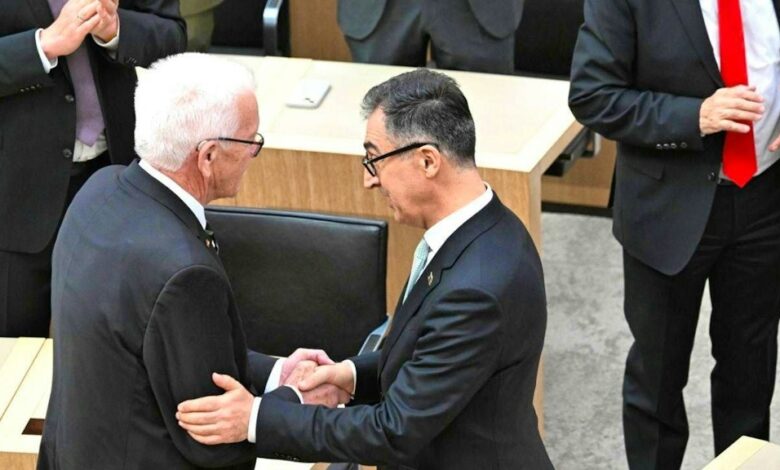
The election, witnessed by a state parliament meeting for the first time in its new composition following the March 8 state elections, solidifies a political alliance that has defined the region for the better part of two decades. Özdemir will lead a renewed “green-black” coalition, joining forces with the Christian Democratic Union (CDU). This partnership is a continuation of a governance model that has already held power in the capital city of Stuttgart for ten years. In the recent state elections, the Greens emerged as the strongest party with 30.2 percent of the vote, narrowly edging out the CDU, which received 29.7 percent. In the new legislature, both parties hold an equal 56 seats, giving their joint faction a commanding majority of 112 votes out of the 155 total seats.
The political maneuvering leading to this coalition was intense. Ahead of the vote, the right-wing populist Alternative for Germany (AfD) proposed Manuel Hagel, the CDU leader for the state, as an opposing candidate for the premiership. Hagel, who is set to become the deputy leader of the new government, received 34 votes in the secret ballot. The AfD parliamentary group comprises 35 members, a testament to the party’s growing influence in the state. Despite this, the mainstream parties maintained a strict firewall against the AfD, with both Özdemir and Hagel explicitly ruling out any cooperation with the right-wing party.
Özdemir’s ascent is a stark contrast to the political trajectory of the state’s previous leader. Winfried Kretschmann, who turned 78 in May and did not seek reelection, was known for his disciplined pragmatism. Under his leadership, the Greens transformed Baden-Württemberg from a traditional CDU stronghold into a Green bastion. However, critics argue that his tenure, while stable, could not prevent policies that negatively impacted the state’s vibrant business sector. The state, home to automotive giants like Mercedes-Benz and Porsche, is one of Europe’s most competitive economic regions, yet it faces the same structural challenges as the rest of Germany: crumbling infrastructure, high energy costs, and deindustrialization.
The new coalition agreement, signed by Özdemir and Hagel on Monday, outlines a five-year program focused on immediate administrative and social reforms. Key measures include the introduction of a free and compulsory final year of kindergarten and significant efforts to reduce bureaucratic burdens on businesses. These policies aim to address the “political malaise” and stagnation that have plagued German federal politics for two decades, a period marked by the long tenure of Angela Merkel and the subsequent “traffic light” coalition.
The broader political landscape in Germany remains fraught with tension. At the federal level, Chancellor Friedrich Merz’s government is hamstrung by its reliance on the Social Democratic Party (SPD), which suffered a severe electoral defeat in Baden-Württemberg, securing only 5.5 percent of the vote. This result reflects a deepening crisis for the SPD, which has seen its traditional base erode by both the Greens and the AfD. For the SPD, the marginalization in the southwest underscores a national trend where social democratic issues are increasingly contested by right-wing parties.
As Özdemir takes the helm, the political significance of his election extends beyond Stuttgart. It represents a continuation of a pragmatic center-right and center-left alliance in Germany’s economic engine room. Yet, the rise of the AfD, which polled around 20 percent in the recent state election, poses a long-term challenge to this stability. The new government must now prove that its “green-black” partnership can deliver the economic dynamism and social cohesion that both the incumbent administration and its critics claim have been lost in the broader German political stagnation.