
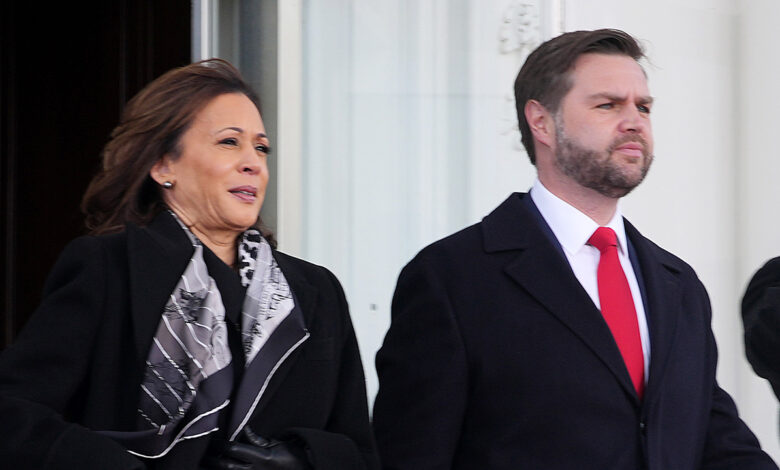
The results indicate that candidates who established large national profiles during the 2024 campaign are currently leading in internal party support. On the Democratic side, former Vice President Kamala Harris holds the top position among respondents who indicated they would be more likely to participate in a Democratic primary. Harris, a former California senator, garnered support from nearly a third of these respondents, capturing a 32% share of the vote. This places her well ahead of Governor Gavin Newsom of her home state, who trails her in the current rankings.
On the Republican side, current Vice President JD Vance commands an even larger share of support among those eyeing the GOP contest. Nearly four in ten respondents stated they would support Vance, giving him a clear lead over other prominent figures. He outpaces two Florida-based politicians who previously sought the presidency in their own right: Secretary of State Marco Rubio and Governor Ron DeSantis. The data suggests that despite the long runway to 2028, Vance has solidified his position as the frontrunner within the Republican primary field.
Trump’s Approval Rating and Generic Ballot Implications
While the 2028 election is two years away, other metrics in the poll offer insights into the current political climate. President Donald Trump has urged supporters to “pretend I am on the ballot” in upcoming elections, yet the data reflects a substantial portion of the population that disapproves of his performance. The survey found that the President’s approval rating stands at 33%, while 58% of respondents expressed disapproval of his job performance.
This negative approval rating appears to influence perceptions of the parties broadly. When asked to choose between a generic candidate from each party, the generic Democrat holds a six-point edge over the generic Republican among all respondents, with 47% supporting the Democrat and 41% supporting the Republican. This advantage becomes more pronounced as the likelihood of voting increases.
Among registered voters, the gap remains at six points, with the generic Democrat securing 49% of support. However, when the sample is narrowed to likely voters, the Democratic advantage expands. In this subset, the generic Democrat crosses the halfway mark, leading the generic Republican by eight points with 52% of the vote. This suggests that as voter engagement increases, the Democratic brand retains a stronger edge in head-to-head comparisons.
These findings highlight a complex political environment where current incumbents face approval challenges, yet their successors or party leaders maintain strong identification with the party base. For Democrats, the early lead of Kamala Harris suggests continuity with the 2024 ticket, while for Republicans, JD Vance’s substantial lead indicates a shift in the party’s primary dynamics. As the 2026 midterms approach, these early indications may shape strategy and messaging for both parties, even as the focus remains on the upcoming congressional elections.
The next major electoral milestone will be the 2026 midterms, where the outcomes will likely set the stage for the 2028 presidential race. Until then, the current polling data serves as a baseline for understanding which candidates have the most immediate name recognition and support within their parties.