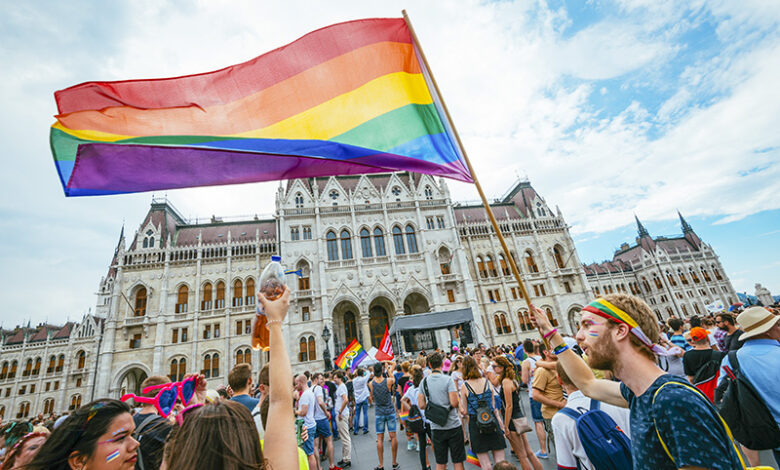
The 2021 Child Protection Law, enacted under former Prime Minister Viktor Orbán’s Fidesz party, had prohibited the “portrayal or promotion of homosexuality or transgenderism” to minors. Although the law was originally framed as a measure against pedophilia, critics and the European Court of Justice argued it was designed to stigmatize LGBTQ+ individuals. The legislation was interpreted broadly, affecting school curricula, sex education, media advertising, and public assembly, including the banning of annual Pride marches in 2025.
The amendment, driven by the current government of Prime Minister Péter Magyar and his Tisza party, retains protections against material that can “seriously impair the child’s physical, intellectual, emotional, or moral development.” However, it eliminates the ill-defined term “promotion,” which had previously been used to target businesses, news outlets, and educators for merely acknowledging the existence of LGBTQ+ people.
Minutes after the vote, Budapest announced that the EU had agreed to unlock the frozen funds. The European Commission stated that the Magyar government had addressed several “rule of law breaches affecting the EU budget,” urging EU leaders to readmit Hungary to key programs such as Erasmus+ and Horizon Europe. The financial release serves as a tangible indicator of the country’s reintegration into the broader European political and economic framework.
Prime Minister Magyar, who defeated Orbán in a landslide election in April, ending 16 years of Fidesz rule, has moved swiftly to dismantle the previous government’s legacy. His Tisza party commands a two-thirds majority in parliament, allowing for the swift passage of these bundled legislative changes. Unlike Orbán, who appealed to conservative voters by framing LGBTQ+ people as a threat to public morals, Magyar has adopted a more neutral stance. He has avoided labeling his government as “liberal” in favor of full equality, instead framing the legal changes as necessary corrections to ensure child safety “regardless of sexual orientation.”
Human rights activists have welcomed the parliamentary vote but caution that the work is incomplete. Tamás Dombos of the Háttér Society, a civil rights group, told the BBC, “We are very happy that this got adopted. We’ve been fighting this so-called child protection law for five years.” While Dombos noted that most issues with the new bill had been addressed, advocates warn that other discriminatory provisions from the Orbán era remain in force.
One such provision concerns adoption. In 2020, the Orbán government amended the constitution to define “family” as headed by a man and a woman, effectively banning same-sex couples from adopting. Until that change, same-sex couples could adopt if one partner applied as a single person, but the new rules required ministerial approval for single applicants, a process that effectively blocked LGBTQ+ adoptions.
Under the new administration, this dynamic has begun to shift. On September 12, Prime Minister Magyar announced that his government would move to end the ban on same-sex adoption. The policy change has already had practical effects; Bence Lakatos and Jozsef Vanyovszki, a gay couple who had been attempting to adopt since 2021, reported that Lakatos was approved to adopt as a single person in August. “We knew there would be changes after April, but actually experiencing this is completely different than merely hoping for something to change,” Vanyovszki said. “It feels incredible to finally be making headway.”
The political context of these changes is significant. During the April election campaign, Magyar largely avoided addressing LGBTQ+ rights, dismissing questions on the issue as a “culture war” distraction. However, since taking office, his government has taken steps to improve Hungary’s international standing by reversing policies that drew heavy criticism from Brussels. In April, ahead of the election, the Court of Justice of the European Union had ruled that Orbán’s government violated European law by stigmatizing gay and transgender people.
The shift in legislative priorities also reflects a broader strategic realignment. Orbán’s Fidesz party, which now holds only 55 of the 199 parliamentary seats, had previously aligned its rhetoric with other populist movements, including those in Russia, to promote nationalist and conservative values. The current government, by contrast, is seeking to repair diplomatic ties and economic relations with the EU, recognizing that the release of frozen funds and the restoration of Hungary’s good standing are critical for its domestic and international stability.
Despite the progress, challenges remain. Same-sex marriage is still illegal in Hungary, with only civil unions recognized. Activists and some members of the LGBTQ+ community, such as Lakatos, hope that the removal of adoption barriers is a precursor to broader marriage equality. “That would allow us to completely eliminate these additional difficulties and rights violations,” Lakatos said.
For now, the immediate political consequence of the vote is the financial and diplomatic normalization of Hungary’s relationship with the EU. The next formal steps will likely involve the European Commission’s final ratification of the funds release and the parliamentary process for amending the adoption laws, which Magyar has signaled is a priority for the current term.