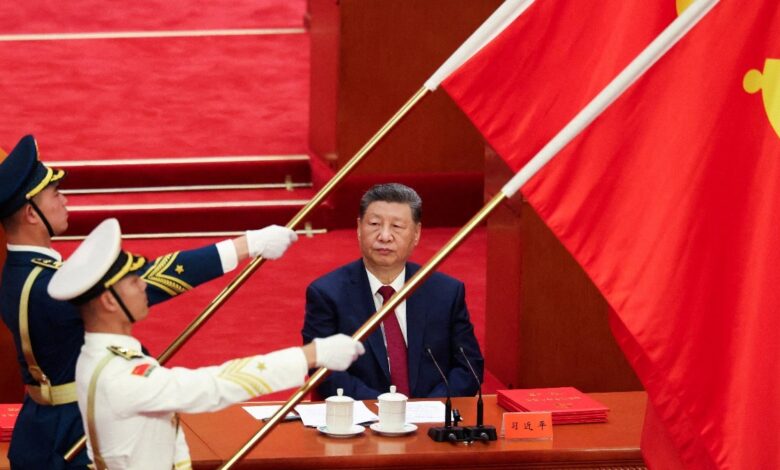
The decision to remove such a large number of senior figures at once is historically unusual and signals a significant shift in the Party’s priorities. Unlike recent plenums that focused on economic reforms and efforts to arrest slowing growth, this meeting placed internal governance and political discipline at the center of its agenda. The plenum also announced plans to hold the next Party Congress next year, where new leadership will be unveiled, effectively shortening the typical cycle and accelerating the leadership transition process.
Unprecedented Military Purge
The most striking aspect of the latest purge is its impact on the People’s Liberation Army (PLA). Sixteen of the 33 expelled officials were from the military, including former senior commanders Zhang Youxia and Liu Zhenli. This deep penetration into the armed forces has raised questions about the stability of the PLA’s leadership, even as Beijing insists the measures are necessary to root out corruption and ensure political loyalty.
The removal of these figures has drastically altered the composition of the Central Military Commission (CMC), the body headed by Xi that oversees China’s armed forces. The CMC is typically a seven-member body, but following the recent purges, it now functions with only two members: Xi himself and General Zhang Shengmin. The plenum further consolidated Zhang’s position by promoting him to the Political Bureau, the Communist Party’s top decision-making body. Zhang, who served as the military’s anti-corruption chief from 2018 until July this year, is considered a key ally in Xi’s efforts to tighten control over the armed forces. His elevation to the Political Bureau marks the first time the body has been restocked in more than three decades, according to Bloomberg.
Record Expulsions and Internal Discipline
The latest batch of expulsions brings the total number of Central Committee members removed during Xi’s third term to 51. This figure stands in stark contrast to the 35 members removed during his first term and only five during his second term, indicating an accelerating pace of internal cleansing. The Party’s anti-corruption watchdog reported that 680,000 people across the party apparatus were disciplined in the first nine months of this year alone.
In its official resolution, the Party acknowledged “the grim reality that party leadership had at times weakened or hollowed out.” It pledged to continue enforcing strict party discipline, describing the campaign as a necessary measure to “turn the knife inwards” to curb disorder. The Party credited Xi’s anti-corruption drive, launched after he took power in 2012, with reversing lax governance and eliminating serious risks within the party, state, and military.
The plenum also confirmed the investigation into Liu Jianchao, the former head of the Communist Party’s International Department, and his removal from the Central Committee. Liu has not appeared in public since August last year and was replaced by Liu Haixing the following month. The move underscores the reach of the crackdown beyond the military into the Party’s diplomatic and international affairs apparatus.
Low Attendance Signals Internal Turmoil
The meeting was also marked by an unusually low turnout among Central Committee members, a detail that has drawn attention from international observers. Only 162 of the committee’s 205 full members attended, representing approximately 79 percent attendance. Another 117 alternate members were present, down from 147 at last year’s meeting. In total, 279 Central Committee members attended the plenum, the first time during Xi’s 14 years in power that attendance at such a gathering fell below 300.
While the specific reasons for individual absences are not established in available reports, the drop in attendance has fueled speculation about internal uncertainty or the chilling effect of the ongoing purges. However, analysts caution that attendance figures alone cannot be taken as definitive evidence of dissent within the Party. The low turnout, combined with the severity of the personnel changes, suggests a leadership environment characterized by heightened scrutiny and strict alignment with the center’s directives.
Strategic Implications for 2027
As China prepares for the 2027 Congress, the current administration appears to be prioritizing political stability and control over economic expansion. By purging senior military figures and elevating loyalists like General Zhang Shengmin, Xi is seeking to ensure the armed forces remain under tight Party control during a period of potential geopolitical tension. The concentration of authority within a smaller, more trusted circle of advisors reflects a strategy to minimize internal challenges ahead of the leadership reshuffle.
The next formal step in this process will be the 20th Party Congress, scheduled for next year, where the new leadership structure will be finalized. Until then, the Party has signaled that the era of leniency is over, with a renewed commitment to “full and rigorous party self-governance” that leaves little room for deviation from the central leadership’s vision.