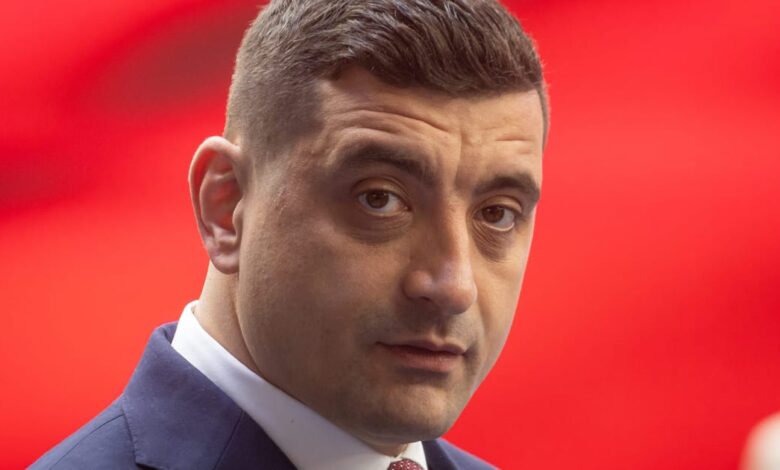
The call for early votes comes amid a significant shift in public opinion. Recent polling indicates that support for AUR has dropped to its lowest point in over a year, a decline that contrasts with Simion’s confident rhetoric. Despite this dip in popularity, Simion maintains that his party holds the key to breaking the impasse. “If the so-called pro-European elites don’t have a solution, the only solution, the constitutional solution, is snap elections,” Simion stated, asserting that the current political class has failed to provide a viable path forward.
Simion’s political stance is distinctly at odds with the trajectory of other European nationalist leaders. While figures such as Italy’s Giorgia Meloni and France’s Marine Le Pen have moderated their Euroskeptical language to gain access to power, Simion shows no such restraint. He described the European Union’s recent policies as destructive to the continent’s economy, stating, “What they want to do in Brussels is to destroy Europe… We are going on the wrong path.” Simion, who describes himself as a “Eurorealist,” criticized the EU’s Green Deal and defense policies, framing Romania’s foreign policy as a struggle against the dominance of larger states. “We have been occupied by these kind of dictators like we have in Russia and we had in U.S.S.R., and dictatorial tendencies from Germany,” he said, adding that Romania seeks to be part of a Europe formed of “free, sovereign nations.”
The political crisis in Romania, the EU’s sixth most populous country, has deep roots in institutional distrust and recent judicial interventions. The current stalemate began in May when AUR joined forces with the Social Democratic Party (PSD) to bring down the liberal-led ruling coalition. Since then, talks on forming a new government have stalled, with no resolution expected before the autumn, as the parliament broke up for its summer break at the start of this month.
Simion places primary blame for the crisis on President Nicușor Dan, the centrist mayor of Bucharest who defeated Simion in the presidential runoff last year. Simion alleges that Dan plotted with the PSD to remove Prime Minister Ilie Bolojan, a move he describes as a failed attempt to create a “mess.” The tension between the two figures is personal as well as political; Simion, who has a background as a football hooligan, previously caused controversy during the election by using derogatory language to describe Dan’s demeanor. In the recent interview, Simion referred to Dan as having a “complicated mind,” a comment that appears to echo his earlier criticisms.
The backdrop to this dispute is a period of intense legal and political upheaval surrounding the integrity of Romanian elections. In December 2024, the Constitutional Court intervened to cancel the presidential elections, citing a vast foreign influence operation that allegedly helped propel far-right candidate Călin Georgescu to lead the first round of voting. Georgescu, who remains a popular anti-establishment figure, is currently on trial in Bucharest on coup charges. Simion argues that this judicial intervention effectively “canceled” democracy, reinforcing his call for a return to the ballot box. “I want to see democracy in Romania… Let the people vote,” he said, dismissing concerns about the reliability of the electorate.
Simion’s political strategy involves a rejection of traditional coalition partners. While he did not fully rule out working with the PSD, he dismissed them as insufficiently radical, arguing they lack the vision to dismantle red tape and reform markets. “They have been running the country for almost 45 years,” Simion said, suggesting that only a new paradigm can prevent Romania from sliding into a “Greece’s situation” of economic stagnation.
Conversely, President Dan and his allies maintain that allowing AUR to form a government would be dangerous. They argue that Simion’s party is anti-Western and too sympathetic to Moscow, a critical concern given Romania’s strategic position on the EU’s eastern flank. Romania plays a pivotal role in European security, providing logistical support for the war in Ukraine and hosting a major NATO base and a U.S. missile defense shield site. Simion has previously proposed halting aid to Ukraine, a stance that has alarmed centrist politicians in Brussels. If Simion were to win power, analysts suggest he could become a more disruptive figure for European mainstream politics than Hungary’s Viktor Orbán.
As the summer break progresses, the path toward a new government remains unclear. The next formal step hinges on whether parties can reach an agreement before the autumn session, or if the pressure for snap elections will intensify, forcing President Dan to dissolve the parliament and call for a historic early vote.