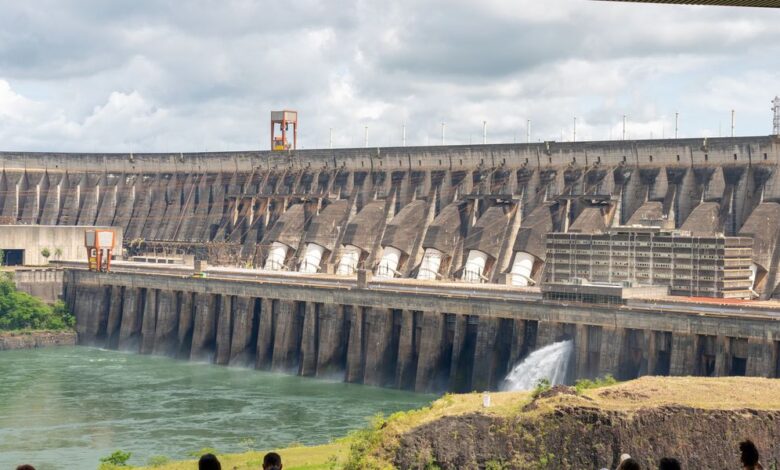
Under the original treaty, Brazil and Paraguay are equally entitled to 50 percent of the dam’s total output. Yet, the distribution of actual usage has been heavily skewed. In 2022, Itaipu met 86.40% of Paraguay’s electrical demand but only 8.72% of Brazil’s. Because Paraguay’s domestic consumption is relatively low, it has historically been required to cede its unused share to Brazil at a preferential price, often below market rates. This arrangement, formalized in “Annex C” of the treaty, has prevented Paraguay from selling its surplus energy to other countries or corporations, effectively locking its primary renewable asset into a bilateral trade that benefits Brazilian industrial capacity more than Paraguayan development.
The economic implications of this structure have been significant. While Paraguay is the world’s fifth-largest energy exporter, it remains one of the poorest nations in South America, with persistent energy poverty in rural areas. The low-cost electricity sold to Brazil has been described by researchers as a subsidy for large multinational corporations operating in Brazil, lowering their operational costs and boosting industrial output. Conversely, the debt incurred during the dam’s construction in the 1970s was substantial. Brazil and Paraguay jointly took on debts of just over USD 3.5 billion at the start of construction. Independent analysts estimate this debt grew to USD 79 billion by the time it was fully paid off in 2023, a figure inflated by refinancing and cost-of-repayment adjustments made by lending banks to recoup losses from the below-cost tariffs used between 1985 and 1997.
Shifting Political Dynamics
The renegotiation is taking place against a backdrop of changing political leadership in both nations. Paraguay’s President Santiago Peña, who took office in 2023, has framed the Itaipu agreement as a “magic key” for the country’s energy transition. Peña has emphasized a shift from a revenue-based policy of selling energy to a development-focused strategy where Itaipu powers domestic industrial growth. This stance contrasts with the previous administration’s approach, which faced scrutiny over secret negotiations with Brazil in 2019 that were criticized for accepting unfavorable terms that raised consumer energy bills.
Brazilian President Luiz Inácio Lula da Silva, returning to office for a third term, has expressed commitment to reaching a fair agreement that accounts for the realities of both countries. During a meeting in March, Lula stated that Brazil views Paraguay as an important ally and is open to negotiations that redefine the partnership. The talks, which began in August of the previous year, aim to address not only tariffs but also the future of the dam in the context of climate change, which may impact future water levels and generation capacity.
Despite the diplomatic engagement, technical and infrastructural challenges remain. Paraguay’s grid has struggled to absorb the full extent of its hydroelectric entitlement, leading to a continued reliance on coal and biomass for fine energy consumption in industrial settings. Senior Industrial Engineer María del Rocio Cueto of the National Electricity Administration (ANDE) noted that burning cheaper natural materials was often preferred over paying high electricity costs due to infrastructure limitations. However, recent investments, such as the inauguration of the YGuazú sub-station, are expected to enhance grid capacity, allowing for greater integration of hydroelectric power and a gradual move away from fossil fuels.
“It has been preferable to burn material, cheap or free, obtained from nature, rather than pay high electricity costs,” said María del Rocio Cueto, reflecting on the historical economic barriers to adopting hydroelectric power in Paraguay.
The environmental impact of the dam remains a key factor in its value proposition. Its daily energy generation curbs approximately 87 million tonnes of CO2 emissions, a quantity equivalent to Paraguay’s entire projected emissions for 2024. As the nations finalize the new treaty, the outcome will set a precedent for cross-border energy cooperation in South America, balancing the need for affordable industrial power with the pursuit of national energy sovereignty and infrastructure modernization.