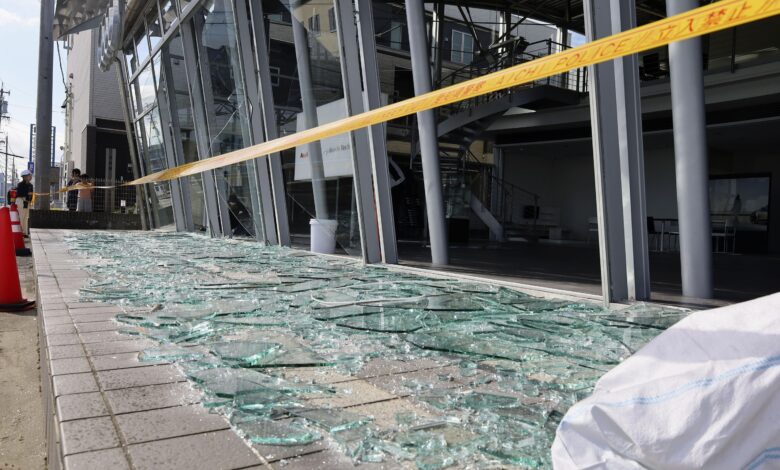
The magnitude of the quake was initially assessed at 5.7 by Japan’s Meteorological Agency (JMA), a figure that aligns with the “strong” classification used in local reporting. However, a slight discrepancy exists in international data, as the U.S. Geological Survey (USGS) reported the magnitude as 5.5. Despite this minor difference in measurement, both agencies confirmed the event’s intensity was sufficient to cause widespread structural damage to non-structural elements, such as glass and shelving, and to result in human injury. At least 22 people were reported injured, with preliminary accounts indicating that many of these injuries occurred when individuals fell from stairs while attempting to evacuate buildings during the shaking.
The geographic scope of the impact extended well beyond the epicenter in Shizuoka. The tremors were felt across a wide area of central Japan, including Aichi Prefecture, where the most violent shaking was recorded according to official seismic assessments. The effects were also documented in the ancient capitals of Kyoto and Nara, as well as in the neighboring prefectures of Yamanashi, home to Mount Fuji, and Gifu. The city of Hamamatsu, located in Shizuoka, was among the areas significantly affected. Notably, the capital city of Tokyo was far enough from the epicenter that the earthquake was not felt there, highlighting the localized nature of the strongest ground motions.
In the immediate aftermath, infrastructure operators moved to ensure public safety. The Shinkansen bullet train network, which relies on precise track alignment, was operated at reduced speeds in the affected regions as a precautionary measure. This standard protocol is designed to prevent derailments or other accidents in the event that the seismic activity has compromised the integrity of the railway infrastructure. Smaller aftershocks were reported following the main event, prompting continued vigilance among residents and emergency services.
Looking ahead, the Japan Meteorological Agency has issued warnings for the coming week, with a particular focus on the next two to three days. Ayataka Ebita, an official with the agency, advised the public to remain alert for secondary hazards, including mudslides, falling rocks, and the compounding effects of rainfall on already stressed terrain. These warnings reflect standard geological risk assessments following significant seismic events, where the stability of slopes and rock faces may be compromised.
A critical point of reassurance was provided regarding the Nankai Trough, a subduction zone off the coast of central Japan where scientists have long monitored for the potential of a “megaquake.” Ebita stated that no apparent change has been detected in the Nankai Trough plate so far. This distinction is vital for understanding the immediate risk landscape; while the current earthquake is a significant local event, it does not currently indicate an imminent rupture of the larger tectonic plate boundary associated with more catastrophic, region-wide seismic potential.
The recurrence of such events underscores the persistent geological reality of living in a seismically active zone. Japanese authorities frequently instruct citizens to maintain preparedness levels that include stocking up on bottled water, food, and batteries. Standard safety protocols, such as having plans to hide under sturdy furniture and keeping comfortable walking shoes accessible, remain central to community resilience. The injuries sustained in this event, primarily from falls during evacuation, serve as a reminder that the primary danger during an earthquake is often not the shaking itself, but the subsequent actions taken in response to it.
As the dust settles on the shattered glass and displaced books, attention turns to the monitoring of aftershocks and the stability of the surrounding landscape. The next verified development will likely involve the results of infrastructure inspections on the Shinkansen lines and any updates from the JMA regarding the seismic activity in the Nankai Trough region.