
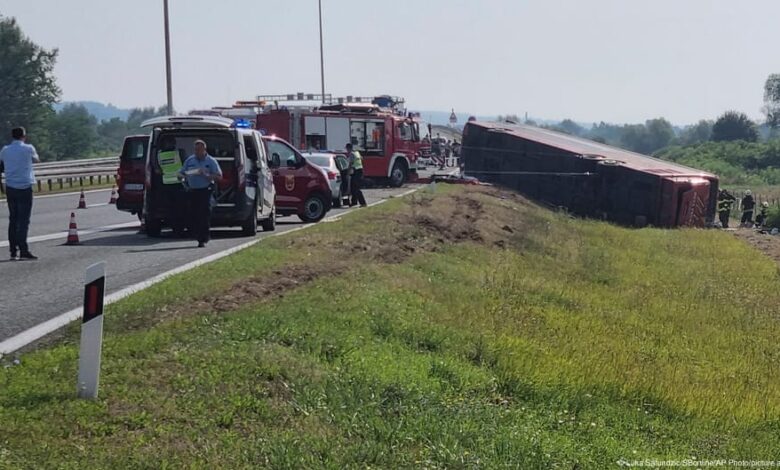
According to official statements, ten people lost their lives in the accident. Damir Trut, the head of the Croatian Civil Protection Agency, confirmed to the press in Slavonski Brod that the deceased included nine passengers and the bus driver. Trut noted that children were among the passengers on board, although he clarified at the time of his statement that it was not yet known if any of the minors were among the casualties. The bus, which bore Kosovo license plates, was operating on a regular route that connected Frankfurt with Pristina. The nationalities and specific ages of the victims had not been released in the initial reports.
The scale of the injuries required a substantial medical response. Head of Slavonski Brod Hospital reported that 44 passengers had been admitted to the facility, with eight patients in serious condition. Civil Protection head Trut provided a breakdown of the 67 passengers and two drivers who were on board: 44 were hospitalized in Slavonski Brod, while 14 passengers and the second driver were being held at the police station, awaiting the provision of accommodation. The specific nature of the injuries for the remaining passengers was not detailed in the immediate aftermath, though the serious condition of eight individuals indicated life-threatening trauma.

Investigations into the cause of the crash are ongoing. Authorities stated that the bus appeared to have swerved or skidded off the highway, but the precise mechanical or environmental factors leading to the loss of control had not yet been determined. The highway was halted to traffic to allow emergency personnel to clear the scene and attend to the injured. The presence of numerous casualties, including children, has drawn significant attention to the incident, with officials emphasizing the tragedy of the event.
High-level responses from the Croatian government underscored the diplomatic and humanitarian gravity of the event. President Zoran Milanović expressed his sympathy on social media, wishing the injured a speedy recovery and acknowledging the sadness of the moment for both the authorities and the people of Kosovo. Prime Minister Andrej Plenković described the news as one of “great sorrow,” extending deep condolences to the families of the victims and the Kosovo authorities. He added a note of hope, stating, “We hope the injured will recover.” Foreign Minister Gordan Grlić Radman also reached out to Kosovo’s Minister of Labor and Social Policy, Donika Gërvalla-Schwarz, to personally convey the condolences of the Croatian government. These diplomatic gestures highlight the international nature of the incident, as the victims and passengers were primarily associated with Kosovo, despite the crash occurring on Croatian infrastructure.
The incident has raised questions regarding the safety of long-distance bus routes across the Balkans and Central Europe, particularly on international highways. While no immediate conclusions have been drawn regarding road conditions or vehicle maintenance, the investigation will likely examine these factors alongside driver fatigue and weather conditions, though specific data on Sunday morning’s weather was not provided in the initial reports. The coordination between Croatian emergency services and the handling of foreign nationals, particularly from Kosovo, will be a key component of the ongoing response. As the investigation proceeds, the Croatian authorities have committed to determining the exact cause of the crash to provide closure to the families of the victims and to inform future safety measures on the highway network.