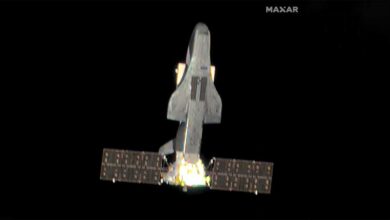

The 2027 Artemis III mission will launch four astronauts aboard the Orion spacecraft on the Space Launch System (SLS) rocket. The mission architecture involves a sequence of independent launches and orbital maneuvers. First, an uncrewed Blue Origin New Glenn rocket will launch a Blue Moon lander test article into Earth orbit. Following this, the SLS will launch Orion with its crew. The astronauts will rendezvous with the Blue Moon vehicle, dock, and verify operational interfaces. Subsequently, a SpaceX Starship lander test article will launch. Orion will undock from Blue Moon and dock with the Starship. According to reporting, the Starship will not yet be equipped with a life support system, and the crew will not enter the vehicle, limiting the scope of the test to docking and interface verification. The entire mission is planned to last up to 17 days.
NASA emphasizes that this orbital rehearsal is necessary to address integration problems in a lower-risk environment than lunar operations. By testing these interactions in Earth orbit, the agency aims to reduce technical risks ahead of the Artemis IV mission in 2028. Agency leaders noted that hardware processing timelines for Artemis III have been reduced by approximately 50%, and a critical fuel-line component was redesigned and tested in-house in five months at roughly one-tenth the cost of previous vendor estimates. Jeremy Parsons, the Artemis program manager, described these efforts as rebuilding core competencies in technical functions rather than outsourcing expertise.
For the 2028 Artemis IV landing, NASA is pursuing two parallel commercial landing systems to maintain flexibility. SpaceX’s Starship architecture involves refueling in Earth orbit before rendezvousing with Orion and traveling to the Moon. Blue Origin’s approach utilizes transfer stages in Earth orbit to push its Blue Moon Mark 2 lander toward the Moon, where it will meet Orion in lunar orbit before descending to the surface. Both companies have revised their designs to improve efficiency and are targeting capability for a 2028 crewed landing. NASA is also evaluating two upper-stage options for the SLS rocket: the existing interim cryogenic propulsion stage and a stretched version of ULA’s Centaur V, which offers greater propellant capacity. Pursuing both options is intended to prevent single-point failures in the launch stack.
Isaacman stated that the campaign must move with urgency as strategic competitors pursue a permanent presence beyond Earth. “We are bringing extreme focus to the mission to ensure delivery of world-changing outcomes as quickly, safely, affordably, and successfully as possible,” he said. The agency acknowledged that while the hurdles are considerable, the goals are within reach. The success of the 2027 orbital test is a prerequisite for the 2028 lunar landing, as it will validate the complex multi-vehicle operations required for sustained American presence on the Moon.