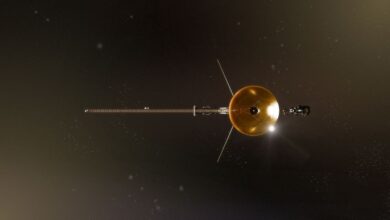
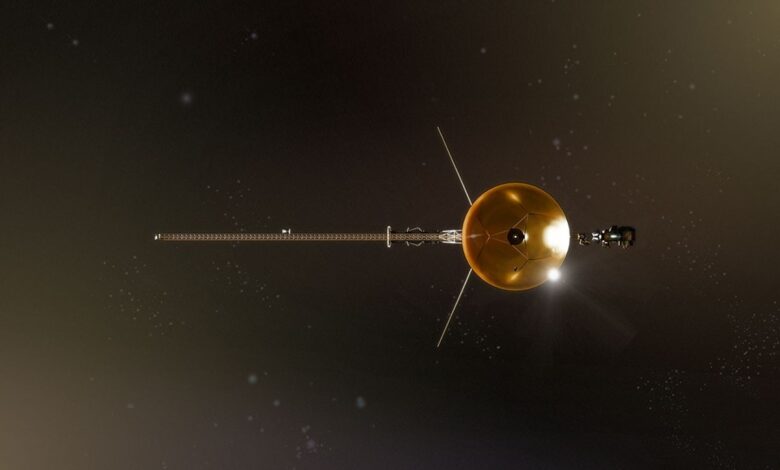
Launched in 1977, Voyager 1 and its twin, Voyager 2, were designed to exploit a rare planetary alignment that occurs once every 176 years. This alignment allowed the probes to perform a “grand tour” of the outer planets. Voyager 1 entered interstellar space in 2012, crossing the heliopause, while Voyager 2 followed in 2018. Both spacecraft continue to operate in the interstellar medium, the region beyond the Sun’s protective magnetic bubble, the heliosphere. Voyager 1 is currently a light-day farther from the Sun than Voyager 2, which is on a trajectory to reach the same distance in November 2035.
The achievement is not merely a marker of distance but a critical juncture for the mission’s longevity. As the probes venture deeper into space, their ability to transmit data and operate instruments is constrained by power availability. The Voyagers are powered by radioisotope thermoelectric generators (RTGs), which convert heat from the decay of plutonium-238 into electricity. Due to the radioactive half-life of the plutonium, both spacecraft lose approximately four watts of power annually. After nearly half a century of flight, this gradual depletion has left the power margins “razor thin.”
To address this, engineers at NASA’s Jet Propulsion Laboratory (JPL) in Pasadena, California, executed a complex power management maneuver on Voyager 2, designated internally as the “Big Bang.” The operation involved simultaneously turning off certain high-power devices and substituting them with lower-power alternatives, a process that required precise coordination to ensure the spacecraft remained warm enough to function. This engineering intervention successfully freed up enough power to keep three of Voyager 2’s 10 science instruments operating for at least an additional year, beyond the previously anticipated end-of-life date for those specific systems.
Without this intervention, the mission team would have been forced to shut down another instrument on Voyager 2 by the end of 2026. Since 2024, the dwindling power supply has already necessitated the deactivation of two science instruments on each spacecraft. Other instruments had been turned off earlier in the mission because they were specifically designed for the planetary flybys and are no longer needed in interstellar space. The “Big Bang” maneuver extends the scientific life of the mission, allowing for continued unique observations of the environment beyond the heliosphere.
The mission team plans to perform the same power-swapping procedure on Voyager 1 in the coming months. Because Voyager 1 is farther from Earth than Voyager 2, it faces even more significant communication delays and power constraints. The successful extension of Voyager 2’s operational window provides a validated template for maintaining Voyager 1, ensuring that both probes can continue to gather data from the interstellar environment for the foreseeable future.
The scientific value of the Voyagers remains high. They are the only objects currently observing the interstellar medium directly. Data from these probes helps scientists understand the boundary between the solar system and interstellar space, including the properties of the heliopause and the density and composition of the interstellar medium. While the spacecraft are not expected to survive indefinitely, the current power management strategies have pushed the timeline for total mission end further into the 2030s and beyond.

As Voyager 1 cruises at nearly 38,000 miles per hour (61,000 kilometers per hour) toward the star AC +79 3888 (Gliese 445) in the constellation Ursa Minor, its proximity to Earth becomes increasingly irrelevant to its scientific function. The probe is expected to pass within 1.7 light-years of that star in approximately 40,000 years. For now, however, its primary role is to serve as humanity’s outpost at the edge of the solar system, providing a continuous stream of data that informs our understanding of the galaxy’s environment.
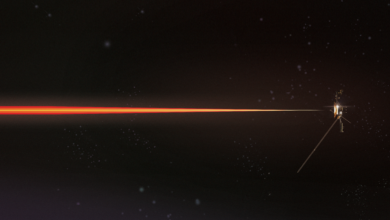
NASA is marking the one-light-day milestone with global events, including a public initiative to create a symbolic wave of light around the planet and a moderated discussion at JPL’s von Kármán Auditorium. These events highlight the enduring legacy of the Voyager mission, which has operated for nearly 50 years far beyond its original design life. The next major focus for the mission team will be the implementation of the power-saving measures on Voyager 1, a critical step in ensuring that the fleet continues to operate and return scientific data as long as possible.