Alpöge posted a statement on his website claiming the discovery, noting that the proof confirms the “Generalized Riemann Hypothesis,” a broader expansion of Riemann’s original conjecture. The mathematical argument was formalized in the programming language Lean, a tool used to verify the logical correctness of each step in a mathematical proof. According to Alpöge, the formalized proof spans over 250,000 pages. Because Lean verifies arguments mechanically, experts expect the technical validity of the code to be checked rapidly, although the mathematical content itself requires rigorous peer review.
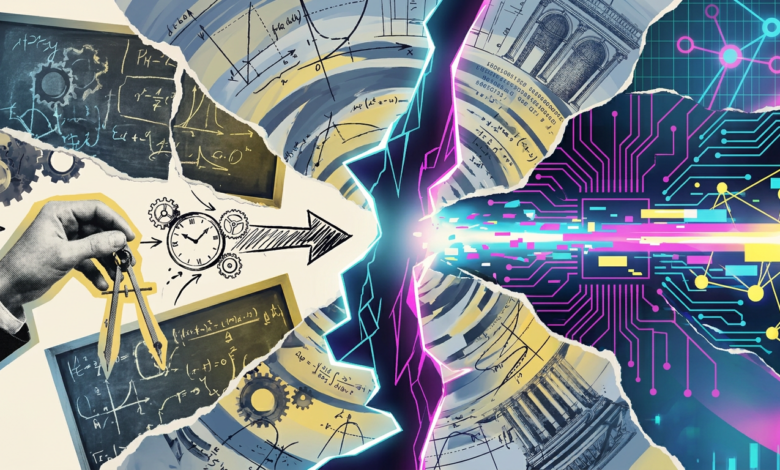
Just hours after Alpöge’s announcement, researchers at Stanford University published a competing draft of a proof that was developed entirely by humans, without AI assistance. The simultaneous release of an AI-generated and a human-generated solution has created an immediate race to verify the results. Mathematicians are currently examining both drafts to determine if they hold up under scrutiny. The situation is unprecedented, as previous attempts to solve the hypothesis were rare due to the lack of an obvious path to a solution.
This development caps a year of rapid advancement in AI’s mathematical capabilities. The text notes that AI performance has ascended from unreliable to a “superhuman force” in the discipline. This momentum was fueled by earlier progress, including an October release by OpenAI that made significant strides in understanding prime number structures. The announcement also follows a record-breaking stock market debut for Anthropic, highlighting the commercial and scientific weight of the company’s developments.
Experts emphasize that these are initial claims, not yet established facts. Hector Pasten, a mathematician at the Pontifical Catholic University of Chile, described a correct proof as a “Rosetta Stone” that would complete a dictionary between different branches of mathematics. Carlo Pagano, a professor at Concordia University and visiting researcher at Google DeepMind, stated that the new ideas in the proof are “very plausible” and could open new avenues in number theory. However, both experts conditioned their assessments on the proof being correct and understood. Alpöge himself acknowledged the emotional impact of the event, describing it as a “loss” for the traditional mathematical community while remaining optimistic about the future.

The immediate next step is the independent verification of both the Lean-formalized code and the Stanford human draft. Until this process is complete, the status of the Riemann Hypothesis remains formally open. The mathematical community is currently focused on checking for discrepancies in the Lean code and reviewing the logical structure of the Stanford argument to determine if either provides a definitive solution.