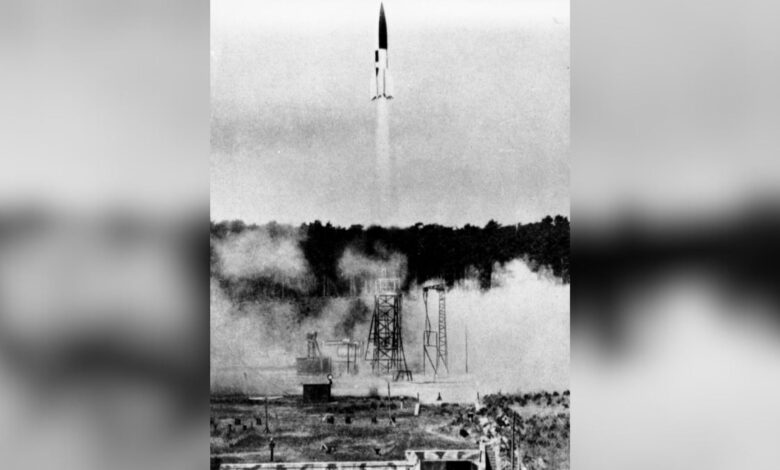
The development of the V-2 was led by German rocket scientist Wernher von Braun. The missile introduced a new element to the battlefield: ultrafast weapon delivery. Capable of traveling at speeds up to 3,400 mph (5,470 kph), the V-2 could carry a 2,200-pound (1,000 kilograms) warhead to targets up to 200 miles (320 kilometers) away. This capability represented a significant leap in ballistic range and speed compared to previous aerial bombardment methods.
However, the scientific achievement was inextricably linked to its role as an instrument of death and terror. Nazi Germany launched its first V-2 in combat on September 6, 1944, and continued using the rockets through March 1945, just one month before the regime surrendered. According to the Smithsonian National Air and Space Museum, the Army and Waffen-SS launched over 3,000 rockets, primarily against London and Antwerp. Despite the volume of launches, the rockets were not terribly accurate and did not lay waste to entire cities in the manner of plane-based bombing raids. The museum notes that the rockets which actually reached populated targets killed approximately 5,000 people.

The human cost of the V-2 program extended far beyond the battlefield. The Smithsonian highlights a stark disparity in mortality figures: an estimated 10,000 to 20,000 concentration camp prisoners died in SS camps connected to V-2 manufacturing. This makes the V-2 a “rare and peculiar weapon,” as more than twice as many people died as a result of making it as did from being hit by it. This grim statistical reality underscores the ethical complexities surrounding the technology’s origins.
Despite its origins in warfare, the V-2’s significance extends into the history of space exploration. The test flight on October 3, 1942, demonstrated what rockets were capable of, effectively ushering the world into the space age by validating the fundamental physics and engineering required for spaceflight. The missile’s performance provided the empirical data and technical insights necessary for future advancements in rocketry.
The legacy of the V-2 program continued after the war through the transfer of personnel and knowledge. Wernher von Braun, who led the development of the V-2, came to the United States after the war. There, he contributed to the efforts of NASA, helping to facilitate the agency’s mission to reach the moon. This transition illustrates how the technical foundations laid by the V-2 program were repurposed for civilian space exploration, bridging the gap between wartime ballistic missile development and the subsequent era of human spaceflight.
The V-2 remains a critical case study in the intersection of technological advancement and ethical responsibility. It stands as a dual legacy: a weapon of mass terror that caused significant human suffering, and a technological breakthrough that opened the door to the exploration of outer space. The data from its test launches and combat use provides a historical baseline for understanding the rapid evolution of rocket technology in the mid-20th century.