
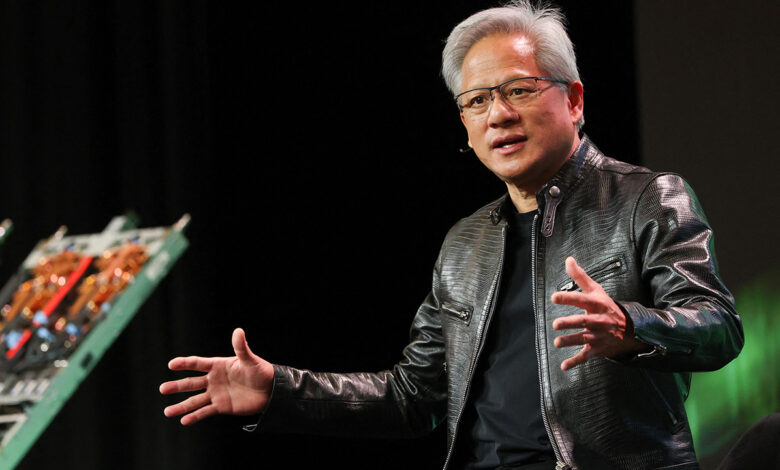
The investigation coincided with Huang’s public admission that he had been unfaithful to his wife, though he did not disclose specific details of the relationship in his initial statement. “My actions hurt her and our children,” Huang said in a statement on Sunday. “There is no excuse for what I did. I am deeply sorry.” In a separate communication to employees, Huang acknowledged the infidelity without elaborating on the nature of the relationship or the individuals involved. The New York Times first reported the relationship last month, noting that Alice Huang had allegedly passed information to Beijing.
Nvidia’s board of directors issued a statement expressing confidence in Huang while clarifying the scope of the inquiry. “While the Board has no reason to believe that either national security or NVIDIA secrets were compromised, the Board’s inquiry will examine all available information,” the statement read. This distinction is critical for investors, as it separates a personal ethical breach from a confirmed corporate security violation. However, the uncertainty has nonetheless affected market sentiment, particularly given Huang’s central role in the company’s strategy and his status as the “most prolific salesman of the AI boom.”

The market reaction highlights the fragility of investor confidence in the AI sector, which has been driven largely by expectations of massive data center build-outs. Chris Weston, head of research at brokerage Pepperstone, noted that the stock drop reflects “a lot of conjecture as to the build-out of data centres.” However, Weston argued that a full-blown “bloodbath” in the stock price would likely only occur if investors genuinely believed Huang would step down. He described Huang as the “godfather of AI” and suggested that the current dip is a reaction to uncertainty rather than a definitive judgment on the company’s long-term viability. Some analysts have noted that Huang has no natural successor within the company, a factor that may mitigate immediate fears of leadership instability.
The incident has also had geopolitical and regional ripple effects. In South Korea, Madison Huang, Jensen Huang’s daughter and an Nvidia executive, cancelled a planned visit to Seoul for an Nvidia conference scheduled to begin on Monday. This cancellation was confirmed by companies she had been set to meet. Meanwhile, shares in Nvidia’s key Asian chip suppliers rebounded on Monday after last week’s selloff, with TSMC closing 4.7% higher, and Samsung Electronics and SK Hynix ending up 0.6% and 0.4%, respectively. This divergence suggests that while the immediate news flow was negative for Nvidia, the broader supply chain remains resilient.
China’s government responded swiftly to the allegations. Guo Jiakun, spokesperson for the Chinese Foreign Ministry, dismissed the “so-called Chinese spy narrative” as “purely a groundless accusation, slander, and a smear.” Megaspeed did not respond to requests for comment, citing a public holiday in Singapore. Alice Huang also did not respond to inquiries from Reuters or The New York Times. The lack of comment from the individuals directly involved leaves the factual basis of the intelligence allegations resting primarily on prior U.S. government investigations and media reporting.
The timing of the disclosure also provided a unique case study in modern financial market mechanics. As traditional equity markets were closed on Sunday, traders turned to perpetual futures—highly leveraged bets that trade 24/7 on cryptocurrency-native exchanges. On Hyperliquid, a decentralized exchange, Nvidia perpetual futures saw significant activity, with the contract slipping to as low as $180.15 on $200 million of volume by 3:30 p.m. ET. This trading occurred well before pre-market equity trading began. Rich Repetto, a former exchange analyst, noted that perpetuals have “filled a significant gap or void in the market” by providing price discovery when traditional markets are offline. Additionally, prediction markets saw a spike in activity, with over $105,000 traded on a Kalshi contract regarding when Jensen Huang might leave as CEO. Pre-market options trading also saw $15 million in premium traded, with slightly more than half of the contracts being puts, indicating a bearish sentiment among early movers.
The situation underscores the increasing intersection of personal conduct, national security perceptions, and market value in the technology sector. While the board maintains that no secrets were compromised, the mere existence of the investigation has introduced a layer of risk that the market is now pricing in. For Nvidia, the challenge is to demonstrate that its operational integrity and strategic direction remain unaffected by the conduct of its CEO. The outcome of the board’s inquiry will be the next critical factor in determining whether this episode is viewed as a manageable personal scandal or a structural threat to the company’s leadership and stability.



One Comment