Route and Force Composition
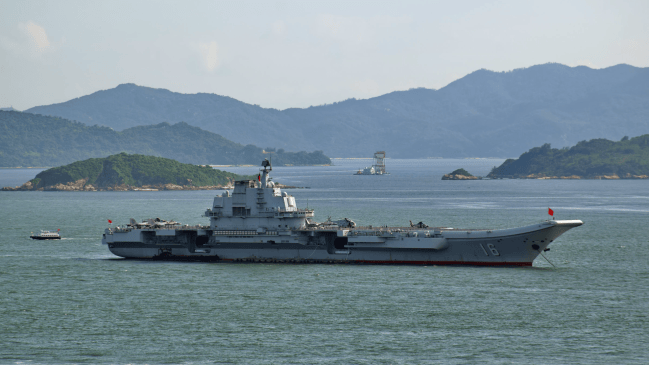
The Chinese carrier group, which began its deployment on October 14, consists of the Liaoning and three guided-missile destroyers: the Type 055 vessels Wuxi and Anshan, and the Type 052D destroyer Huainan. Japan’s defense ministry reported that the group passed through the Miyako Strait on October 14 to enter the Pacific, turned toward the South China Sea on October 15, and subsequently headed toward the southern Philippines. This anticlockwise movement around the Philippine archipelago reverses the course taken during Chinese exercises in October 2024, according to reports from the South China Morning Post.
Philippine naval vessels reportedly shadowed the group as it sailed near the country’s southwestern coast. The Armed Forces of the Philippines (AFP) spokesperson for the West Philippine Sea, Retired Rear Admiral Roy Vincent Trinidad (Reserve), stated that the passage off Mindanao is “not a cause for alarm.” This assessment suggests that Manila views the transit as a routine maritime activity rather than a provocative maneuver aimed at disrupting regional stability or the ongoing Keen Sword drills.
Operational Context and Surveillance
The deployment represents the Liaoning’s second round of drills in the western Pacific this year. The carrier group is expected to remain deployed for several weeks, extending its presence beyond the “first island chain”—the geographic line stretching from Japan through Taiwan to the Philippines. Operating beyond this chain allows Chinese forces to train in the wider Pacific, while US and allied forces utilize regional exercises like Keen Sword to practice coordination across maritime and air domains.
Earlier in the month, Japanese authorities detected Chinese aerial surveillance assets operating near the carrier, including a Y-9 electronic reconnaissance aircraft and a WZ-7 high-altitude unmanned aircraft. It remains unclear whether these platforms continued south with the carrier group. The USS Theodore Roosevelt, a Nimitz-class aircraft carrier, is operating in the Philippine Sea with allied warships as part of the Keen Sword framework, according to the US Navy’s 7th Fleet.
Strategic Significance and Precedent
The simultaneous presence of two carrier groups in the western Pacific highlights the increasing frequency of high-end naval operations in the region. While the overlap does not inherently indicate a confrontation or Beijing’s intent to disrupt the exercise, it underscores the complex dynamics of freedom of navigation and freedom of overflight in contested waters.
Previous incidents have illustrated the potential for friction during such deployments. In a report aired by Chinese state broadcaster CCTV, Beijing noted that Japanese ships and aircraft repeatedly shadowed the Liaoning group during far-sea training in June. The report stated that the Type 054B frigate Luohe warned off Japanese vessels, while J-15 fighters operating from the carrier intercepted Japanese P-3C maritime patrol aircraft. These historical interactions suggest that while current operations may remain passive, the proximity of opposing naval assets carries inherent risks of miscalculation or escalation if rules of engagement are not strictly observed.
For now, the situation remains one of parallel operations. The strategic consequence of this deployment lies not in immediate tactical engagement, but in the sustained demonstration of Chinese naval endurance and the ability to project power beyond the first island chain, challenging the traditional maritime dominance of US and allied forces in the western Pacific.