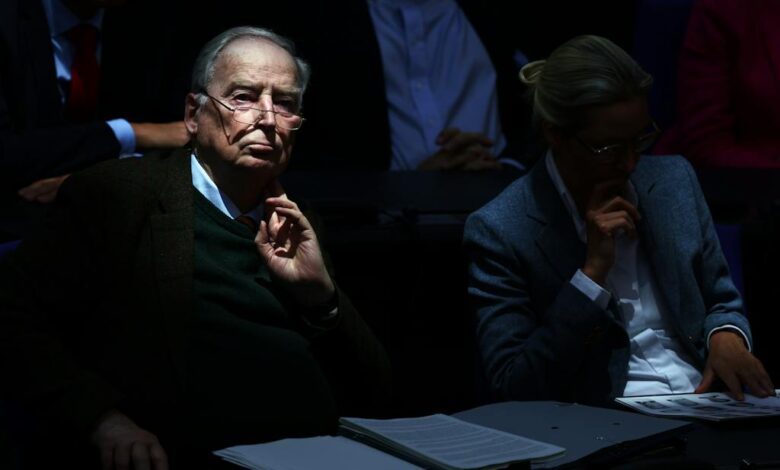
Gauland, who was re-elected to the Bundestag in February 2025, has already undergone three surgeries and is currently receiving chemotherapy. According to Wall, the politician’s ability to attend plenary sessions in the lower house of the German parliament is now contingent upon the progression of his medical treatment. Since the beginning of 2025, Gauland has been able to attend Bundestag sessions only to a limited extent. During the current legislative session, his participation has been sparse; he has cast a vote in only 47 of the 85 roll-call votes held to date, with his last recorded vote occurring in July. For the time being, Gauland is working from home, though Wall indicated that he hopes to return to the chamber in person once his health permits.
This health development intersects with a political career defined by both institutional prominence and significant controversy. At 85, Gauland is the oldest member of the current Bundestag. He secured his seat in the February 2025 federal election by winning 32.2 percent of the first-preference votes in the Chemnitz district. While his age and health status now dictate his physical presence in parliament, his political influence remains embedded in the AfD’s structure. The party, which entered the Bundestag for the first time in September 2017, has grown into Germany’s main opposition force, a trajectory fueled by discontent over migration policies and a desire to redefine Germany’s historical self-perception.
Gauland’s public persona has long been a focal point for debate regarding Germany’s relationship with its past. As a former member of the Christian Democratic Union (CDU) and a journalist before entering politics, Gauland has consistently advocated for a reevaluation of German history. In a speech delivered in September 2017, he argued that Germans have the right to be proud of their soldiers’ achievements in both World Wars, drawing parallels to French pride in Napoleon and British pride in figures like Nelson and Churchill. He stated that the 12 years of Nazi rule did not relate to modern German identity and that the nation needed to “reclaim its history.”
These positions have drawn sharp criticism from across the political spectrum. A particularly contentious moment occurred when Gauland described the Nazi era as “just bird poo” in over 1,000 years of successful German history, a remark made during an address to the party’s youth wing. The comment triggered widespread outrage. German President Frank-Walter Steinmeier, speaking at a memorial event for victims of the Holocaust, accused those who play down the Nazi dictatorship of ridiculing millions of victims and sowing new hatred. Annegret Kramp-Karrenbauer, then general secretary of the CDU, tweeted that the remark exposed the party’s true nature behind its “mask of respectability.” Even within the AfD, the statement was criticized; parliamentary group head Jörg Meuthen called it a “really unfortunate remark and inappropriate choice of words,” though Gauland defended the phrase as one of the most scornful descriptions in the German language, denying any intent to insult victims.
The intersection of Gauland’s health and his political legacy raises questions about the future dynamics within the AfD. While he remains a symbolic figure as a co-founder, his reduced physical presence in the Bundestag may shift internal power dynamics, particularly as the party navigates its role as the primary opposition. The uncertainty surrounding his treatment timeline means that his ability to directly influence legislative proceedings in the near term remains limited. Whether he will be able to resume regular attendance in the plenary sessions depends entirely on his medical recovery, a factor that introduces a degree of unpredictability to the party’s parliamentary strategy.
As Gauland continues his treatment, the political attention remains fixed on the broader implications of his career. His statements on history and identity have solidified his status as a polarizing figure, capable of energizing his base while provoking condemnation from other parties and state institutions. The coming months will likely see a continued focus on both his health and the political direction of the AfD, with his potential return to the chamber serving as a key indicator of the party’s operational readiness in the ongoing legislative session.