The event occurs against a backdrop of a significant constitutional confrontation between President Karol Nawrocki and Prime Minister Donald Tusk. This political standoff has raised critical questions regarding the stability of Poland’s democratic institutions, its relationship with the European Union, and its role in European security. The crisis centers on competing claims of constitutional authority, particularly concerning judicial appointments that are supported by European judicial institutions but are being obstructed by the presidential administration.
Analysts note a historical irony in the timing of the celebration. Poland commemorates 11 November as the day it recovered independence in 1918 after 123 years of partition by neighboring empires. While modern Poland is a sovereign democracy embedded in NATO and the EU, with international guarantees that did not exist in the 18th century, the historical period serves as a cautionary tale regarding institutional cohesion. The current political paralysis mirrors the vulnerabilities that historically contributed to the country’s partition, suggesting that formal independence is insufficient without functional, credible institutions.
The core of the current dispute involves the legitimacy of recent judicial reforms. Prime Minister Tusk’s government argues that restoring judicial legitimacy requires procedures that command legal credibility. Conversely, President Nawrocki maintains his right to defend constitutional authority, even as he indefinitely obstructs appointments. Neither side has been able to resolve the conflict through mobilization or legal declarations alone. The 2027 parliamentary elections may shift the political balance, but electoral victory is not guaranteed to settle the underlying constitutional disagreements.
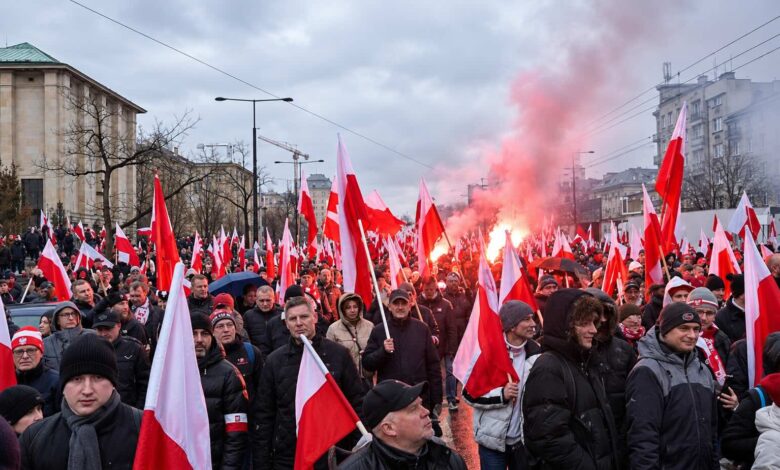
Wednesday’s Independence March will serve as a measure of nationalist mobilization. However, the more consequential test for Poland will be its ability to recover institutional functionality under rules accepted by all political actors, including those who lose power. For a country increasingly central to Europe’s security architecture, the resolution of this internal conflict has implications that extend well beyond Polish borders.
The march comes in the wake of other recent tensions, including a violent attack at a Benedictine abbey in Jarosław on 24 September, which resulted in the death of one priest and injuries to others. That incident fueled online disinformation and anti-Ukrainian narratives, highlighting the broader social and political fragility that the Independence Day events must navigate. The next major political milestone remains the 2027 parliamentary elections, which are expected to determine the future direction of Poland’s internal governance and its alignment with European institutions.