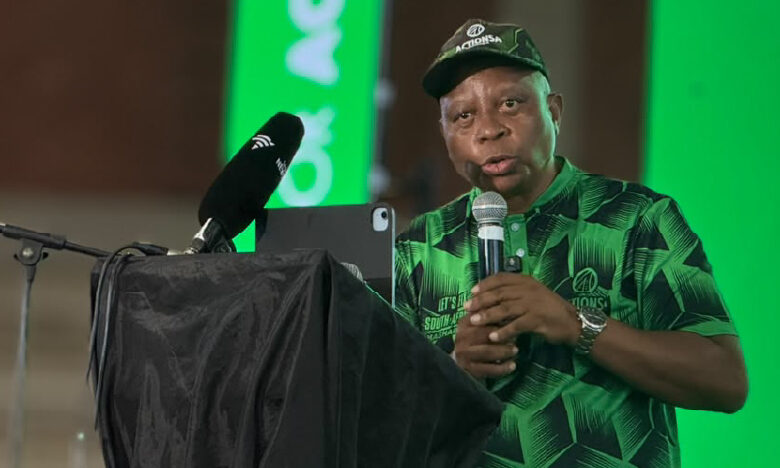
Mashaba responded to what he characterized as “arrogance” from political commentators, analysts, and supporters of rival parties who have attempted to dictate ActionSA’s path. “I will not be bullied into making political decisions,” Mashaba said. “ActionSA’s independence is not up for negotiation.” He emphasized that the party operates with its own leadership, principles, and mandate from supporters, rejecting claims that it functions as an extension of the Democratic Alliance (DA), the African National Congress (ANC), or any other organization.
The firm stance by Mashaba occurs against a backdrop of intense coalition negotiations in South Africa’s economic heartland. Reports indicate that ActionSA is moving closer to a deal with the ANC in several Gauteng metropolitan areas, a development that risks leaving the DA without coalition partners in key jurisdictions. The DA has historically relied on alliances with smaller parties to secure majorities in metros such as Johannesburg, Tshwane, and Ekurhuleni, where the ANC’s vote share has declined in recent cycles.

Mashaba drew a direct line to his 2019 resignation from the DA and the City of Johannesburg, citing fundamental disagreements over the party’s direction, its approach to inequality, and its prioritization of party interests over local governance. He noted that his departure followed the election of Helen Zille as the DA’s Federal Council Chairperson. Mashaba stated that while ActionSA previously collaborated with the DA to prevent ANC control of key metros, the DA’s subsequent entry into the ANC-led Government of National Unity (GNU) after the 2024 national elections breached the trust established within the Multi-Party Charter.
“In May 2024, the DA entered into discussions with the ANC following the national elections,” Mashaba said. “The DA subsequently joined the ANC-led Government of National Unity. ActionSA raised serious concerns about this conduct and the breach of trust within the Multi-Party Charter. We ultimately walked away from that arrangement.” He argued that coalition agreements should be viewed as pragmatic, situational partnerships judged on their immediate administrative merit, rather than permanent ideological alliances.

Critics of Mashaba’s position, including political analyst Ivor Blumenthal, have warned that his hostility toward the DA threatens the stability of coalition government in Gauteng. Blumenthal argued that a coordinated axis between the DA and ActionSA across multiple metros is essential for predictable governance in South Africa’s economic hub. However, Mashaba dismissed such external assessments, stating that his leadership has endured political battles to build a movement focused on ordinary people, and he would not allow his authority to be undermined by those without accountability for the party’s direction.
As the deadline for constituting councils approaches, the outcome of these negotiations will determine the balance of power in Gauteng’s major metropolitan municipalities. The DA has not officially responded to Mashaba’s latest comments, but the situation underscores the fragility of the current political landscape in the province.