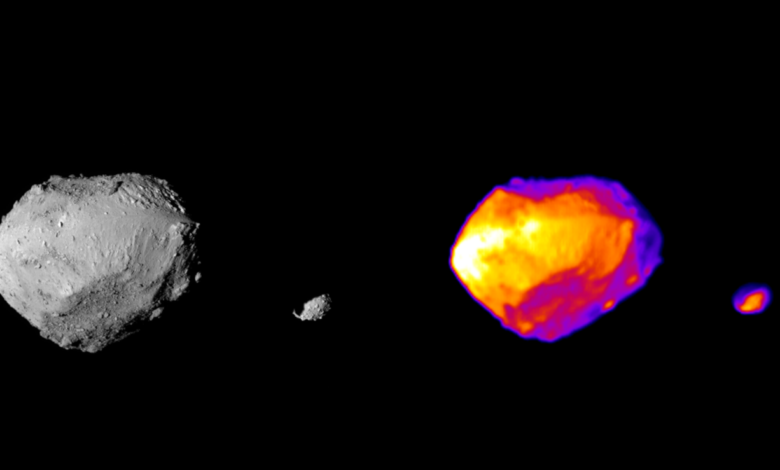
The Double Asteroid Redirection Test (DART) was conceived as a critical rehearsal for a potential future threat involving a near-Earth asteroid. By slamming a spacecraft directly into a tiny space rock, engineers and scientists sought to validate the kinetic impactor technique—a method designed to divert an object hurtling toward Earth. While the primary metric of success was the measurable change in the asteroid’s orbital period, the new visual evidence provides a deeper understanding of the physical consequences of such an intervention.
Dimorphos, the target of the collision, is a small moonlet orbiting the larger asteroid Didymos. Crucially, neither Dimorphos nor its parent body posed any threat to Earth at the time of the mission. The object was selected specifically as a safe testbed to evaluate whether a spacecraft impact could reliably nudge a space rock off course. The collision, which took place in 2022, was described by BBC science editor Rebecca Morelle as being “like something out of a disaster movie,” a characterization that underscores the dramatic nature of the event and the high stakes involved in testing humanity’s first line of defense against an extraterrestrial impactor.
The new images, released four years after the event, show the extent of the damage done to the asteroid’s surface. The creation of a crater the size of a stadium indicates that the impactor transferred a substantial amount of energy into the asteroid’s structure. This is not merely a superficial scuff; the transformation of the surface suggests that the collision altered the regolith and potentially the internal cohesion of the small body. For planetary defense planners, this is vital information. If a future mission requires deflecting a hazardous asteroid, the physical state of that object after the strike must be accurately modeled, as changes in mass distribution or surface integrity could affect the object’s trajectory in the long term.
The assessment of this aftermath is not the sole domain of NASA. The European Space Agency (ESA) has deployed a spacecraft named Hera to the Didymos system to scour the scene. Hera is currently conducting a detailed survey of the collision site, aiming to fully assess the aftermath of the 2022 event. This collaborative effort between major space agencies highlights the international importance of planetary defense. By combining NASA’s data from the DART mission with ESA’s ongoing observations from Hera, scientists are building a comprehensive dataset on how small asteroids respond to high-velocity impacts.
It is important to distinguish between the confirmed success of the orbital deflection and the newly observed surface modifications. The primary goal of DART was to prove that a kinetic impactor could change an asteroid’s path, a hypothesis that was supported by the mission’s results. The discovery of the stadium-sized crater and the resulting surface transformation represents a secondary but scientifically profound outcome. It moves the discussion beyond simple trajectory calculations to include the material properties and structural integrity of asteroids. Understanding how an asteroid breaks or craters under impact is essential for predicting its behavior in the chaotic environment of space, where it may be subjected to further gravitational perturbations or, in a worst-case scenario, additional impacts.
The significance of these findings extends to the reliability of our planetary defense strategies. The fact that the message sent to “any asteroids that might threaten a collision with Earth” was “even more powerful than they already knew” refers to the efficacy of the technique. The mission successfully demonstrated that humans possess the capability to alter the course of a space rock. However, the new images also serve as a reminder of the complexity of such interventions. The “rehearsal” revealed that the act of defense leaves a permanent mark on the target, altering its physical form in ways that must be accounted for in future mission planning.
As Hera continues its operations, the focus will remain on correlating the visual data with the orbital measurements taken post-impact. The next critical step in this scientific endeavor is the integration of Hera’s high-resolution imaging with the broader dataset from DART. This will allow researchers to refine models of asteroid material strength and impact mechanics. The ultimate goal remains unchanged: to ensure that if a threatening asteroid is ever detected, humanity has a verified, tested, and understood method to protect the Earth. The transformation of Dimorphos stands as both a testament to successful engineering and a complex puzzle that planetary scientists are now working to solve.