
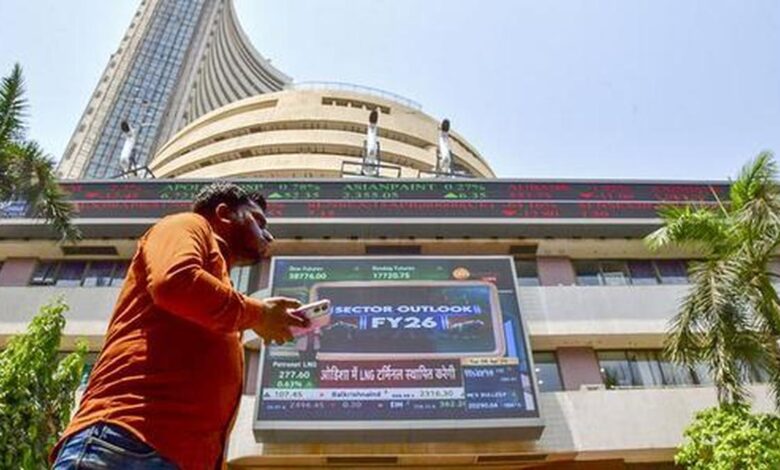
The 30-share BSE Sensex jumped between 1,097 and 1,302 points during early trade, closing out the session’s initial moves near 82,409, a gain of approximately 1.61 percent. Similarly, the 50-share NSE Nifty 50 rallied by over 330 points, or 1.32 percent, to trade above 25,375. This marks a significant gap-up start compared to the previous trading day’s close, as investors returned from the Diwali-Balipratipada holiday break with bullish positioning.
The primary driver of this upward momentum has been the reversal in foreign institutional investor (FII) flows. After two consecutive months of substantial capital flight—characterized by net outflows of ₹35,861 crore in September and ₹34,843 crore in October—FIIs turned net buyers in the first nine days of November. According to NSDL data, foreign portfolio investors invested a net ₹53,739 crore in Indian equities during this period. Exchange data further confirmed that FIIs purchased equities worth ₹7,212.22 crore on Monday alone, providing immediate liquidity and confidence to the market.
Complementing the capital inflows was a favorable external macroeconomic environment, specifically regarding energy costs. Brent crude, the global oil benchmark, which had settled 1.17 percent lower at $91.49 a barrel on Tuesday, traded at approximately $92.44 per barrel on Wednesday. This price level is well below the $96.93 recorded on Monday and represents a significant moderation from recent highs. The drop in oil prices follows remarks by US President Donald Trump suggesting that the conflict with Iran might de-escalate, although a US naval blockade in the Strait of Hormuz remains in place. For India, a major net importer of crude oil, this price relief is a direct positive for its current account deficit and import costs, thereby supporting the broader economic outlook.
The rally was broad-based across market capitalizations, indicating widespread investor confidence rather than concentration in a few large-cap names. The Nifty Smallcap 100 gained over 1 percent, while the Nifty Midcap 100 rose nearly 1 percent. Within the Nifty 50, only three stocks declined, with Mahindra & Mahindra leading the gainers at 3.13 percent, followed by InterGlobe Aviation (IndiGo) at 2.62 percent and Asian Paints at 2.29 percent. Sectoral indices reflected this strength, with the Nifty Auto index topping the list of sectoral performers, up 1.53 percent, while the Nifty Private Bank index rose 1.32 percent.
Market sentiment was further bolstered by positive cues from Asia, where major indices posted gains: Taiwan’s market rose 2.09 percent, South Korea’s Kospi increased 1.47 percent, and Japan’s Nikkei gained 0.80 percent. This regional strength provided a supportive backdrop for Indian equities, even as Wall Street ended its Tuesday session in the red. The US market decline was attributed to a rout in semiconductor and chip manufacturer stocks, triggered by controversies involving Nvidia CEO Jensen Huang, which dragged major US indices lower. However, the US VIX, a measure of market volatility, eased by 2.31 percent to 19.46, suggesting that panic selling in the US was contained and did not immediately translate into risk-off behavior in emerging markets like India.
Domestic volatility indicators also pointed to improving confidence. The India VIX, the market’s fear gauge, cooled by 2.18 percent to 17.04, indicating a reduction in perceived risk among domestic traders. Technical analysts have noted that the combination of strong momentum and fresh FII buying provides underlying support for the indices. Deepesh Sarawagi, a technical research analyst at Choice Broking, highlighted that the broader market setup continues to favor bullish trends, with the recent inflows helping to stabilize the market after the AI-linked sell-offs seen in global markets earlier in the year.

Despite the strong performance, the market remains cautious about geopolitical risks. While President Trump’s comments have eased fears of an immediate new escalation in the Iran conflict, officials have noted that no imminent deal has been reached. The persistence of the naval blockade in the Strait of Hormuz continues to pose a potential risk to global shipping and oil supply chains, which could impact commodity prices if the situation deteriorates. Investors are watching these developments closely, as any resurgence in oil prices could reverse the current tailwind for Indian equities and other import-dependent economies.
The current rally brings the Nifty 50 to within 997 points of its 52-week high of 26,373.20. The market’s ability to sustain these gains will depend on continued foreign investment, stable crude oil prices, and the resilience of domestic corporate earnings. The upcoming data releases and policy decisions will be critical in determining whether this rally marks a structural shift in market sentiment or a temporary rebound driven by short-term factors.




3 Comments