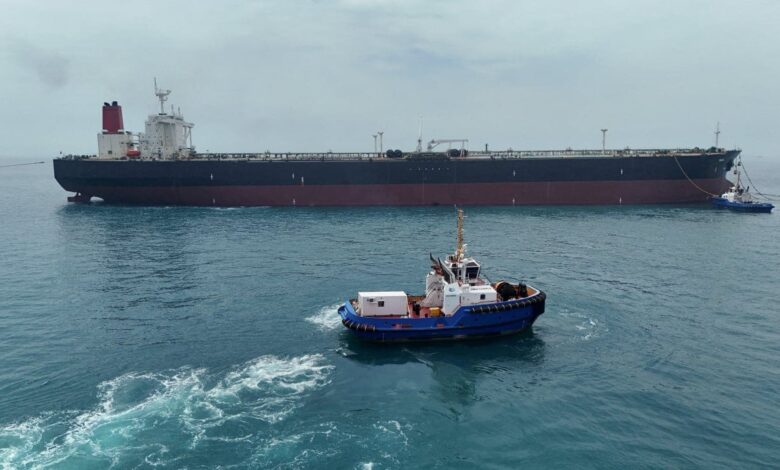
According to an advisory note from the United Kingdom Maritime Trade Operations (UKMTO), the incident occurred 25 nautical miles (46 kilometers) northeast of Oman’s Khasab. The UK-based maritime security organization confirmed that the vessel, which it did not name in its initial report, suffered no environmental impact and resumed its journey to its next port of call. However, three maritime security sources assessed that the *Louise 1* was the specific target. This assessment is significant because it represents the first known successful strike using limpet mines in the area since the conflict began. Prior to this, two sources noted a separate attempt in September using similar devices, but those mines did not detonate.
The deployment of limpet mines by a small craft presents a distinct tactical challenge to naval and maritime security forces. Greece-based maritime risk management group Marisks described the tactic as “cheap, low-tech and very efficient,” noting that the apparent ability of a small vessel to approach a transiting tanker, deploy explosives, and withdraw quickly poses a significant security concern. Marisks added that limpet mines were first deployed in the region in 2017 and have been used against tankers in the Strait of Hormuz in subsequent years, emphasizing that the devices are readily available and inexpensive. The cramped and congested nature of the strait’s shipping lanes further complicates defensive measures, as the speed and maneuverability of small attack boats make them difficult to intercept without risk of collateral damage to commercial traffic.
This attack occurs against a backdrop of repeated incidents targeting commercial shipping in and around the Strait of Hormuz since February. Iran has been hitting vessels it claims have violated its restrictions on passage through the waterway, a strategy aimed at asserting control over the strait and exerting diplomatic and economic pressure on Washington. In a related development on Friday, the Iranian Revolutionary Guards Navy (IRGC) announced that two other oil tankers had been stopped in waters south of the Strait of Hormuz. According to the IRGC, these vessels had switched off their navigation systems, ignored radio warnings, and attempted to use an unauthorized route through the strategic waterway. While the IRGC framed these actions as enforcement of their maritime restrictions, the accumulation of such incidents underscores a growing pattern of coercive measures in the region.
The *Louise 1* itself has a history of involvement in geopolitical flashpoints. In July, Ukrainian forces struck the same tanker with naval drones in the Black Sea. Ukraine’s Security Service (SBU) stated that the attack was a response to the vessel’s role in transporting Russian oil as part of Moscow’s “shadow fleet,” a network of tankers deployed to keep Russian oil exports flowing despite international sanctions. The operator of the *Louise 1*, listed in shipping databases as Aquarius Maritime Ventures and based in Panama, could not be reached for comment. The juxtaposition of the vessel being targeted by Ukraine in the Black Sea and now by an unknown party in the Gulf highlights the fragmented and multi-front nature of the current maritime security environment, where commercial assets are caught between competing state interests and non-state actors.
It remains unclear who is responsible for the limpet mine attack in the Strait of Hormuz. While the timing and location suggest potential involvement by Iranian-aligned forces seeking to assert dominance over the waterway, no official claim of responsibility has been made for this specific incident. The IRGC’s announcement regarding the stopping of two other tankers serves as a reminder of Tehran’s stated intent to regulate traffic in the strait, but the use of limpet mines is a tactic that has historical precedence in the region without a single attributed perpetrator. Marisks’ assessment that the methodology is “very efficient” suggests that such attacks may become more frequent if the current security posture remains unchanged, as the low cost and high impact of the weapons lower the threshold for potential attackers.
The immediate consequence of the *Louise 1* incident is a renewed scrutiny of navigational risks in the Strait of Hormuz. For global energy markets, the strait remains a critical artery, and any disruption to the flow of oil and gas has immediate economic repercussions. The transition from drone strikes and missile threats to close-quarters contact mines indicates a shift in the tactics employed by those seeking to disrupt shipping. As the US and Iran continue their conflict, the Strait of Hormuz remains a focal point where diplomatic pressure, military posturing, and asymmetric warfare intersect. The safety of the crew and the lack of environmental damage in this instance are positive outcomes, but the incident serves as a stark reminder of the vulnerability of the global supply chain to low-tech, high-impact asymmetric threats.
As the *Louise 1* continues to its next port of call, the question of attribution remains open. The incident adds another layer to the complex security dynamics in the Gulf, where the lines between state-sponsored enforcement and irregular warfare are increasingly blurred. The next development to watch will be whether this tactic is repeated by other actors in the region or if it leads to a formal diplomatic response regarding the security of the waterway.