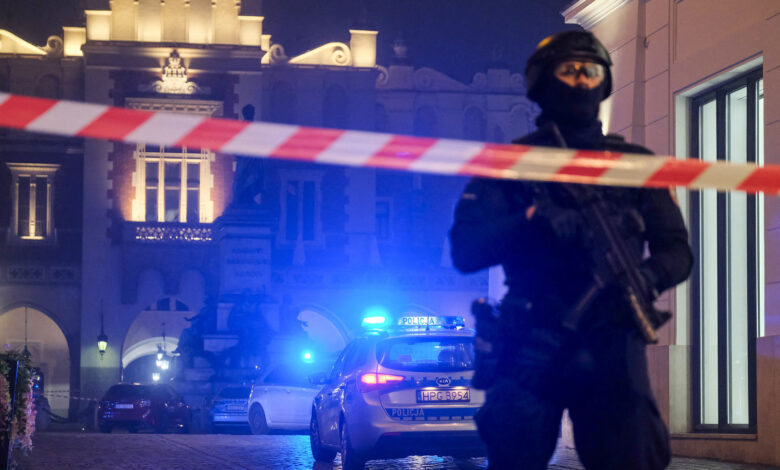
The attack, which took place in the historic center of Poland’s second-largest city, resulted in the deaths of six people and injuries to at least 15 others, according to various official counts. The victims included four women and two men. Among the dead were a British citizen and an Austrian woman. Authorities noted that five foreign nationals from the United Kingdom, Portugal, Russia, Germany, and Austria were among the wounded. Two police officers who intervened to stop the gunman remain hospitalized in serious condition, though both were conscious as of Sunday afternoon.
Polish prosecutors have opened an investigation into the killings and attempted killings, including attacks on police officers, under the legal framework of a possible terrorist offense. Justice Minister Żurek remarked that the gunman “acted with the aim of seriously intimidating a large number of people,” which is the defining legal characteristic of a terrorist crime in this context. However, the legal status of the motive remains under active inquiry. While Interior Minister Marcin Kierwiński initially stated that the suspect was “fascinated by far-right ideologies,” government spokesman Adam Szlapka later advised restraint, noting that until the matter is fully clarified and authorities possess complete information, it is best to refrain from definitive comments. This shift in official communication prompted criticism from nationalist opposition politicians, including Przemysław Czarnek, who demanded explanations for the basis of the interior minister’s initial statements.
Separate from the events in Kraków, police discovered the bodies of the suspect’s mother, father, and sister at their family home in Ostrowiec Świętokrzyskie, a city approximately 93 miles (150 km) northeast of Kraków. Prosecutor’s Office spokesperson Daniel Prokopowicz stated that it is “highly likely” the same person carried out the killings in both locations, though investigations are ongoing. The three victims in Ostrowiec Świętokrzyskie had gunshot wounds, and authorities recovered seven firearms and a significant quantity of ammunition from the property. The suspect faced murder charges in connection with these deaths as well.

The legal proceedings will focus on distinguishing between the established facts of the violence and the unproven allegations regarding ideological motivation. While the suspect’s death precludes a criminal trial for the Kraków shooting, the investigation into the circumstances of the family killings and the potential involvement of others remains open. Justice Minister Żurek emphasized that evidence is being collected but will not be disclosed, asking the public for restraint. The case highlights the procedural complexity of investigating mass violence where the primary suspect is deceased, requiring authorities to rely on digital evidence, ballistic analysis, and witness testimony to determine the extent of the network and the specific legal classification of the crimes.
For the families of the victims and the broader public, the immediate consequence is the continuation of forensic and investigative work without the prospect of a criminal judgment against the primary perpetrator. The legal system in Poland will rely on the findings of the prosecutor’s office to determine if additional charges can be brought against associates or if the case remains isolated to the deceased individual. The next formal step in the legal process will be the conclusion of the preliminary investigation, which may lead to further indictments if evidence of conspiracy or other participants emerges, or a final determination of the incident as a solitary act.