
The ballot question arises from growing tensions over how Switzerland should respond to global crises, particularly following the 2022 Russian invasion of Ukraine. Although not a member of the European Union, Switzerland joined EU sanctions against Moscow after a brief period of hesitation, freezing billions of dollars in Russian assets and halting trade. While this move was welcomed by many younger Swiss citizens and prompted days of pro-Ukraine protests in major cities, it angered traditionalists who view such actions as a weakening of the nation’s neutral status. These traditionalists successfully collected the required signatures to force the nationwide vote, arguing that the current interpretation of neutrality has compromised Swiss safety.
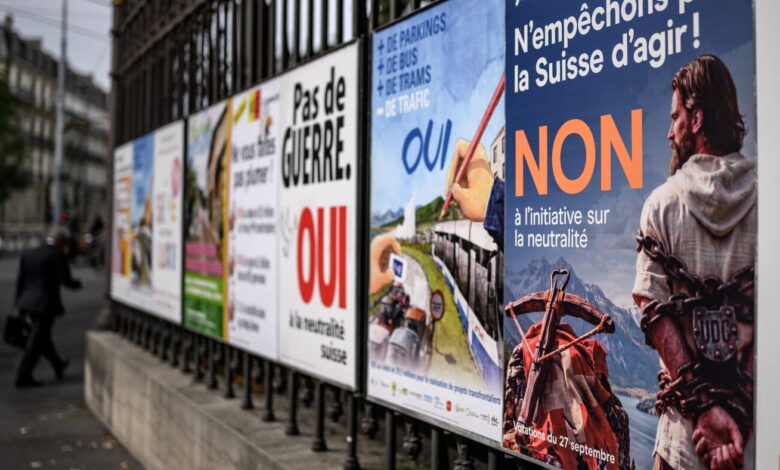
Christoph Blocher, the 85-year-old leader of the right-wing Swiss People’s Party, is the primary architect of the campaign. Blocher, who has spent decades opposing Swiss integration with European institutions, argues that the EU sanctions have damaged Switzerland’s standing. “We’ve hurt our neutrality with these EU sanctions,” Blocher told a rally of supporters. “Now Russia thinks we’re part of the war.” Campaign posters across the country emphasize this message, promising “No war” if voters support the stricter constitutional definition. However, opponents argue that maintaining neutrality in the face of unprovoked aggression is morally indefensible.
Fabian Molina, a Social Democrat member of parliament, criticized the initiative, drawing parallels to Switzerland’s historical refusal to join sanctions against apartheid South Africa. “We therefore supported directly the racist regime and prolonged apartheid in South Africa,” Molina stated. He argued that refusing to join EU sanctions against Russia would create a similar ethical vacuum. “And this is morally wrong,” Molina added, suggesting that the initiative’s supporters have ulterior economic motives. Molina noted that Blocher’s businesses traded with South Africa during the apartheid era and with Russia until 2022, implying that a lack of sanctions facilitates commerce with controversial regimes.
Supporters of the initiative maintain that the current framework allows for too much political interference in Swiss independence. The proposed constitutional change would require that any participation in military cooperation be limited to cases where Switzerland is under attack or such an attack is being prepared. Furthermore, the ban on unilateral sanctions would effectively render the mechanism useless in the current geopolitical climate, as the five permanent members of the UN Security Council—the U.S., China, Russia, France, and the United Kingdom—rarely agree on collective actions.
Switzerland’s neutrality was originally imposed by the major European powers in 1815 after the Napoleonic Wars, serving as a buffer zone between France and the Austro-Hungarian Empire. This status allowed the country to avoid direct involvement in two world wars and the Cold War. The basic premise has been that keeping foreign armies off Swiss territory would keep the country out of other nations’ conflicts, while trading with all sides would maintain the economic connections vital to its welfare state. Neutrality has been enshrined in the Swiss constitution since 1848, but its practical application has evolved significantly over two centuries.
Despite the passionate campaign, polling data suggests the initiative is likely to be rejected. Current surveys indicate that approximately 63 percent of voters intend to vote against the proposal. Analysts note that this outcome reflects a preference for maintaining the flexibility of Swiss foreign policy rather than a rejection of neutrality itself, which remains a core component of Swiss national identity. The vote will determine whether Switzerland continues to adapt its neutral stance to contemporary international norms or retreats into a more rigid, isolationist framework.
The next scheduled step is the official announcement of the referendum results following the close of polls on September 27. If the initiative is rejected, the current framework for neutrality will remain unchanged, allowing Switzerland to continue participating in EU-led sanctions and maintaining its current level of diplomatic flexibility. If passed, the constitutional amendments would take effect, legally binding the government to the stricter restrictions on military and economic engagement abroad.