
The site in question is slated to house three buildings, each standing 85 metres tall, which Microsoft has committed to renting in full. The project’s origins date back to 2016, when plans were first filed. This timeline is central to the current controversy: in 2016, Amsterdam had not yet implemented a ban on new data centres within the city. However, after the city imposed such a ban, the provincial government granted permission for the project to proceed in January. Critics argue that this regulatory pathway allows the facility to bypass current Dutch rules governing very large data centres, a claim that has fueled local opposition.
The protest action was not merely a local dispute over zoning. Nathan Timmer, a representative of Geef Tegengas, a group translating its name as “Push Back,” stated that the objective was to halt construction entirely. “We don’t want it to be built. Nobody needs it,” Timmer told local broadcaster AT5. He characterized the intended use of the facility as being for “AI slop, AI warfare, data surveillance and committing genocides,” reflecting a broader skepticism toward the applications of artificial intelligence and the opacity of its infrastructure.

The technical and environmental grievances are specific and quantifiable. Geef Tegengas asserts that the data centre will consume as much electricity as all households in Amsterdam combined. Furthermore, the group claims the project will slow the construction of 30,000 new homes, a concern echoed by city officials who have warned that shortages on the power grid threaten plans for new residential and school infrastructure. The group, which also campaigns against fossil fuels, accused police of improper conduct during the event, stating that the right to protest had been ignored after the mayor banned the demonstration earlier in the morning and police blocked the march’s path to the site.
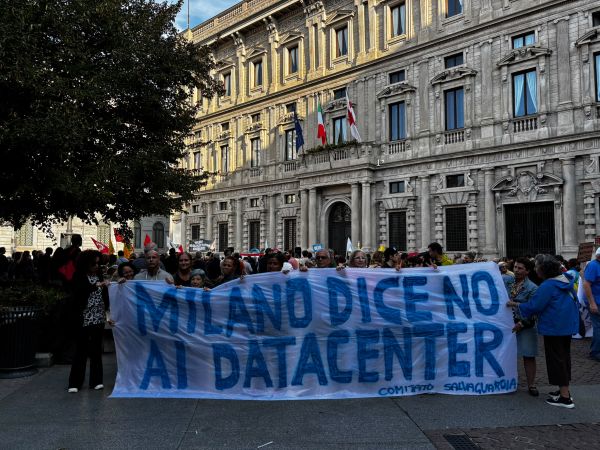
This incident in Amsterdam is part of a coordinated two-day action, planned for November 6 and 7, against data centres across Europe. Owen Espley, coordinator of StopDirtyDataCentres.eu, noted a growing disconnect between political rhetoric and public sentiment: “There’s a gulf between where elected leaders are at in terms of buying into the hype about AI and where people are at.” Civil society groups in 15 European countries, including Ireland, Poland, and the UK, are participating in “Stop Dirty Data Centres” events this weekend.
The momentum appears to be gaining political traction as well. In Germany, a dozen protesters gathered outside a data centre on the outskirts of Berlin, with spokeswoman Caro Weber stating, “We want to put a stop to this blind construction of data centres around Germany… This is really, really dangerous for our future.” In Poland, approximately 100 people demonstrated in front of the Parliament in Warsaw, representing communities near planned centres. In Italy, opposition is intensifying in the Lombardy region, the country’s primary hub for digital infrastructure. These local actions follow the US midterm elections, where Democratic candidates promised to regulate data centres, citing their high resource consumption.

Microsoft acknowledged the protest, stating that it respects the right to express views peacefully but does not condone unlawful actions that threaten safety. The company had not issued a broader public comment on the specific allegations regarding energy consumption or the project’s regulatory status at the time of reporting. The site has faced previous disruptions; in July, Extinction Rebellion activists threw balloons filled with acid and paint over the fence, indicating a sustained pattern of opposition to the facility.
The Amsterdam incident underscores a broader shift in how European societies are engaging with the physical infrastructure of the digital economy. As the demand for compute power for AI scales, the competition for grid capacity and land use is becoming a focal point for civic unrest. The distinction between announced projects and those that can actually be built—given power grid constraints and regulatory hurdles—is now a central issue for regulators and technology companies alike. While Microsoft proceeds with the rental of the facility, the legal and social challenges posed by the “Stop Dirty Data Centres” movement are likely to shape the regulatory landscape for data centre development across the continent in the coming months.