
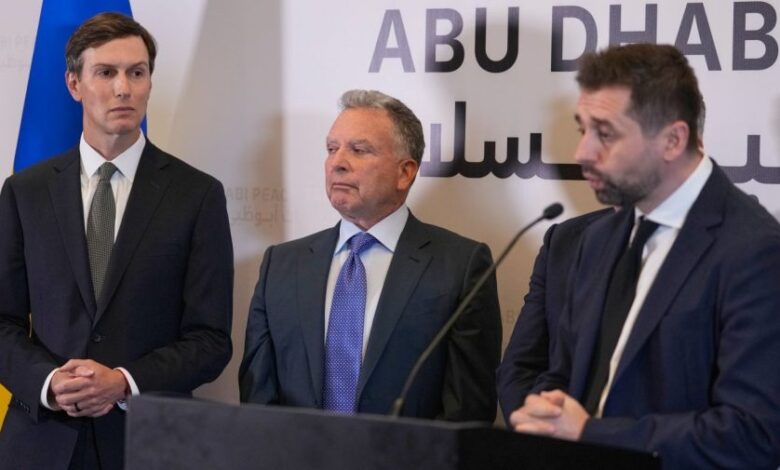
The two-day talks, hosted in the United Arab Emirates, represented a significant break in the diplomatic freeze that had persisted for roughly nine months, a hiatus attributed to the war in Iran. The resumption of dialogue was a high-stakes endeavor, mediated by the United States, which sought to re-engage both Kyiv and Moscow in a structured conversation. While the prisoner swap constitutes a verified humanitarian achievement, the absence of a broader peace breakthrough has shifted the focus of international analysis away from the immediate humanitarian relief and toward the structural complexities of the conflict.
The central tension emerging from the Abu Dhabi sessions is not merely between Russia and Ukraine, but increasingly between the United States and its European allies regarding the approach to Moscow. Washington’s mediation role has highlighted a deepening split in Western strategic thinking. The U.S. appears to be pushing for direct engagement and incremental gains, such as prisoner exchanges, to maintain a diplomatic channel open. In contrast, European visions, shaped by the prolonged duration of the war and the security implications for the continent, have often leaned toward a more integrated approach that links humanitarian gestures to broader security guarantees and territorial integrity. This divergence was exposed during the talks, where the limited scope of the agreement—focused on prisoners rather than ceasefires or territorial status—illustrated the difficulty in aligning these differing diplomatic philosophies.
For Ukraine, the prisoner swap is a critical victory, primarily for the families of the detained soldiers and for restoring a degree of morale. However, Kyiv’s delegation likely viewed the talks through the lens of long-term security. Umerov’s reference to “opportunities” suggests that Ukraine is willing to engage where it can gain tangible benefits, but it remains wary of signaling weakness or accepting terms that do not address the fundamental causes of the conflict. The return of negotiators to their capitals to “finalize details” indicates that the agreement is not yet fully binding, introducing a layer of uncertainty. The mechanics of such a large-scale exchange are complex, involving the verification of identities, the logistics of transport, and the legal frameworks governing the release. Any delay or complication in these final steps could undermine the political capital generated by the initial agreement.
Russia’s participation in these U.S.-mediated talks signals a willingness to engage in specific, controlled diplomatic channels, even as the military conflict continues. For Moscow, the prisoner swap serves as a diplomatic victory, demonstrating its ability to negotiate directly with the West and Ukraine without necessarily conceding on the broader strategic objectives of the war. By agreeing to the exchange but refusing to move on other fronts, Russia maintains its leverage while appearing cooperative. This tactic allows Moscow to manage international perception, portraying itself as a rational actor open to humanitarian concerns, while insulating itself from pressure to make substantive concessions on the battlefield or in terms of territorial control.
The role of the United States as the primary mediator is itself a subject of geopolitical scrutiny. By facilitating the talks, the U.S. has reasserted its centrality in the conflict, but the limited outcome raises questions about the efficacy of its strategy. The nine-month hiatus caused by the war in Iran had allowed the diplomatic channels to atrophy, making the revival of these talks in Abu Dhabi a difficult endeavor. The fact that the talks ended with a prisoner swap but “no breakthrough” suggests that the U.S. mediation has hit a ceiling. The American approach, which seeks to stabilize the situation through incremental deals, may be at odds with the European desire for a more comprehensive settlement that ensures long-term stability in the region. This rift complicates the formation of a unified Western front, which is crucial for maintaining sanctions pressure and providing military support to Ukraine.
The historical context of prisoner exchanges in this conflict is significant. Past swaps have often been ad hoc and limited in scope, driven by specific national interests or humanitarian crises. The “large-scale” nature of this agreement, as described by Umerov, marks a departure from that pattern, indicating a higher level of coordination and trust, at least on this specific issue. However, the lack of linkage to other diplomatic tracks, such as grain exports, energy security, or nuclear safety, underscores the fragmented nature of the peace process. Each issue is being negotiated in silos, which may allow for quick wins on individual fronts but fails to address the interconnected nature of the geopolitical crisis.
As the negotiators return to their capitals, the implementation of the prisoner swap will be the immediate test of the talks’ success. The public will watch closely for the release of the first groups of prisoners, a moment that will bring the abstract diplomatic language back to the human level. For the families waiting, the news from Abu Dhabi is a beacon of hope, but for policymakers, it is a reminder of the narrow path forward. The deepening split between U.S. and European visions means that achieving a comprehensive peace will require bridging not just the gap between Kyiv and Moscow, but also the gap within the Western alliance. The Abu Dhabi talks have opened a door, but the room beyond it remains dark, and the lights are not yet on.
The unresolved tension lies in whether the momentum from the prisoner swap can be leveraged into broader negotiations. If the details of the exchange are finalized smoothly, it could create a precedent for further diplomatic engagement. However, if the process stalls, it will reinforce the perception that diplomatic channels are dead ends, leading to a return to the status quo ante of the nine-month hiatus. The next development will likely be seen in the official confirmations from Kyiv and Moscow regarding the logistics of the swap, a step that will determine whether the “opportunities” identified in Abu Dhabi become reality or remain a fleeting diplomatic gesture.




One Comment