
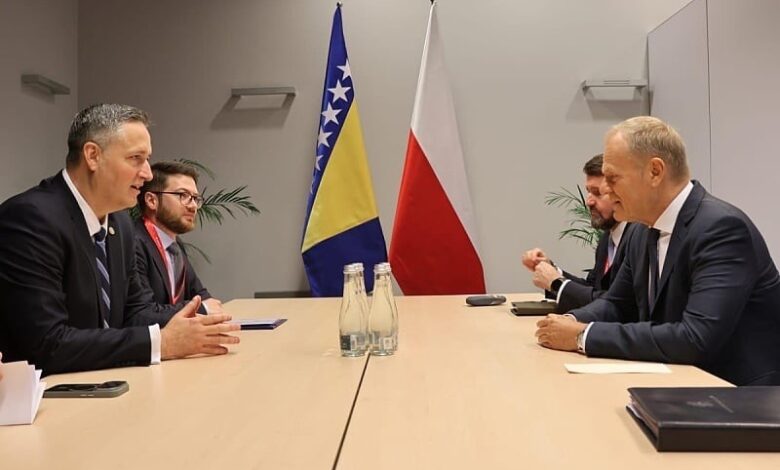
During the discussions, Bećirović noted that Bosnia and Herzegovina and Poland are marking the 30th anniversary of the establishment of diplomatic relations this year. He stated that the two countries currently have no outstanding issues and identified significant opportunities to deepen political, economic, and security cooperation. Specific areas for intensified engagement included energy, agriculture, investments, tourism, and communication infrastructure. Bećirović also expressed gratitude for the contribution of the Polish Armed Forces within the European Union’s Althea mission, noting their role in peace support operations in Bosnia and Herzegovina as part of the EUFOR framework.
The meeting addressed the country’s ongoing path toward European and North Atlantic alliance membership. Bećirović reiterated Bosnia and Herzegovina’s commitment to full membership in the EU and NATO, citing strong support for this trajectory among the country’s citizens. However, he accused leaders of the Republika Srpska (RS) entity of blocking this progress. According to the official announcement, the RS leadership coordinates its policy with Moscow rather than Brussels, a stance Bećirović described as destructive to the Dayton Peace Agreement and regional stability. He stated that Poland’s sanctions against the former president of the RS entity are justified in light of these actions.

Prime Minister Tusk responded by confirming Poland’s support for the independence, sovereignty, territorial integrity, and constitutional order of Bosnia and Herzegovina. He emphasized that the Republic of Poland remains committed to strengthening cooperation and providing support for the stability, security, and democratic development of the Western Balkans.
The diplomatic exchange occurs against a backdrop of established security frameworks in the region. Following the 1992–1995 war, NATO played a central role in implementing the Dayton Peace Agreement through peacekeeping deployments from December 1995 to December 2004. The NATO-led Implementation Force (IFOR) was deployed in late 1995 to enforce the military aspects of the agreement and was subsequently replaced by the Stabilisation Force (SFOR) a year later. These operations facilitated reconstruction and maintained a secure environment, laying the groundwork for the current European Union-led Althea mission in which Polish forces participate.
Bećirović stressed the necessity of strengthening the resilience of state institutions and improving cooperation among European partners to confront what he termed destructive forces. The agreement on high-level contact intensification suggests a continued alignment between Sarajevo and Warsaw on the need to counter external influences that may undermine the country’s integration into Western institutions.
The next phase of these diplomatic efforts will likely involve concrete measures to operationalize the discussed cooperation in energy and security, while the political standoff regarding the Republika Srpska entity’s influence remains an unresolved issue in Bosnia and Herzegovina’s path to EU and NATO membership.