The pontiff’s two-day visit to the Canary Islands, a Spanish archipelago off the coast of Morocco, serves as a direct counterpoint to political narratives that characterize migration as a crisis or an invasion. “You are not numbers or files, you are people,” Pope Leo told a gathering of migrants, stating that he “bowed” before their dignity. This message resonates in a region that has become a primary entry point into Europe for individuals traveling from West Africa. While the spiritual dimension of the visit is central, the economic and social implications are equally significant, particularly regarding the labor force and the political debate over integration.
Current data from the United Nations High Commissioner for Refugees (UNHCR) indicates that the number of sea arrivals to Spain has fallen significantly this year. This decline is partly attributed to increased interceptions off the West African coast by naval patrols funded by the European Union. However, the reduction in arrivals does not signify the end of perilous journeys. The Pope emphasized the need for “legal and safe pathways,” warning that Europe’s conscience must not become “accustomed” to its seas turning into unmarked graves. He cited the disappearance of entire boatloads as a critical failure of current systems, urging a focus on preserving life over containment.
The human cost of these routes is illustrated by the experience of Bakary Jaiju, a 19-year-old from the Gambia who arrived in Tenerife late last year. Jaiju spent seven days at sea in a wooden boat carrying approximately 160 people, including women and children. “You can’t even sleep in case you fall in,” Jaiju recalled, explaining that his motivation was to improve the financial condition of his family, despite leaving behind his wife and baby son. After being rescued off the tiny island of El Hierro when their fuel ran out, he spent three months in a migrant camp before joining a local integration project.

Jaiju’s subsequent journey highlights the economic dynamics of migration in the region. He is now part of a cohort of young migrants being supported by the Good Samaritan Foundation, a project led by a local priest known as Padre Pepe. The foundation provides accommodation and workshops to about 170 young men, addressing a gap in social services where local authorities typically only support migrants until they reach the age of 18. “The streets will eat you up, young people are like carrion there,” the priest said, describing the vulnerability of those who age out of state protection. He argued that the local labor market has a “huge demand” that could absorb these workers, questioning why political attitudes have hardened despite the potential economic benefits of integration. “If we do it well, integrate people well, there is nothing bad in it at all. Quite the contrary,” he stated.
The practical outcome of these integration efforts is currently being shaped by a significant policy shift in Madrid. The Spanish government, led by President Pedro Sánchez, has launched a one-off regularization process allowing hundreds of thousands of undocumented migrants who arrived before last December to apply for residence and work permits. For individuals like Jaiju, this represents a rare opportunity to secure legal status, moving from temporary survival to stable employment. The priest’s team is currently working to help migrants submit their paperwork before the deadline, a process that transforms their economic trajectory from precariousness to participation in the formal labor market.
This policy, however, has triggered a sharp political disagreement that underscores the tensions within the European migration framework. The conservative Popular Party has condemned the move as “irresponsible,” arguing it contradicts broader EU immigration policies. The far-right Vox party has been more vocal, labeling the influx an “invasion” that will lead to the “collapse of the health service, housing and security.” These arguments stand in contrast to the government’s position, which frames the regularization as a mix of humanitarian obligation and pragmatic labor management. The debate reflects a wider uncertainty about the economic and social capacity of European nations to absorb and integrate new arrivals while maintaining public services.
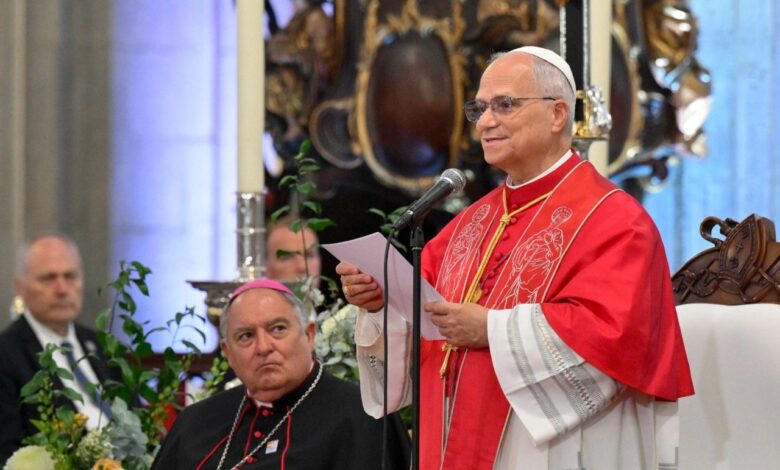
During his meeting with bishops, priests, and pastoral workers in St. Anne’s Cathedral in Las Palmas de Gran Canaria, Pope Leo urged the Church to remain united in its response to these challenges. He drew on the imagery of the sea surrounding the islands, noting that while it represents home, it also symbolizes challenge and uncertainty. Quoting Saint Augustine, he stated that “no one is able to cross the sea of this world unless they carry the cross of Christ.” This theological framework supports the practical work of organizations like Diocesan Caritas and the Migration Ministry, who helped organize the papal audience. Enélida Hernández Monzón, the General Secretary of Pastoral Care, described the visit as a “double surprise and a double joy,” noting that the Pope’s presence affirms the work carried out by local communities over centuries.
The visit concludes with a focus on the Eucharistic life of the Church, with the Pope highlighting local traditions such as showering flower petals before the Blessed Sacrament. Yet, the economic and social realities of the Canary Islands remain in the foreground. The port of Arguineguín, once a symbol of institutional failure, is now a site of renewed attention. As the regularization deadline approaches, the next critical step will be the successful processing of applications and the entry of these workers into the labor market. Whether the local economy can indeed “absorb” these individuals, as local advocates claim, while addressing the security and service concerns raised by political opponents, will determine the long-term impact of this policy on the region.