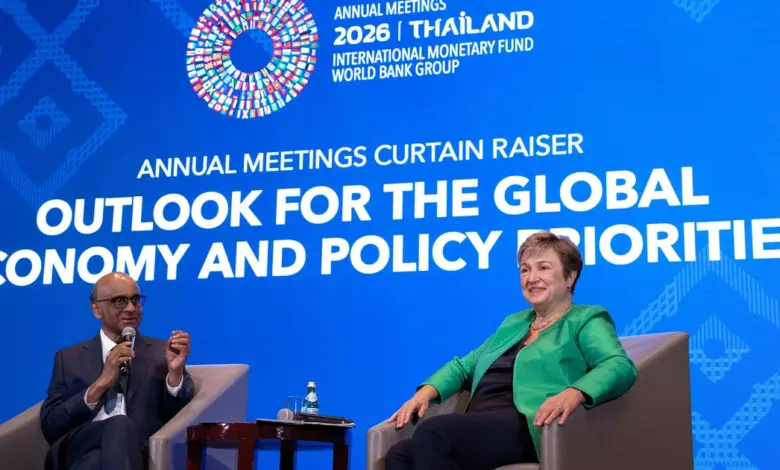
Georgieva, who has led the IMF since 2019, highlighted that global public debt is near its highest levels since World War II. She stated that total debt is on track to soon exceed 100 per cent of gross domestic product. This trajectory is occurring alongside a sharp rise in benchmark borrowing costs, with 10-year sovereign yields in the United States, Germany, and Japan reaching their highest levels in decades. Georgieva identified developed economies as the “worst offenders,” noting they generally carry higher debt-to-GDP ratios than emerging and lower-income economies.
“Global public debt is near its highest levels since World War II, and is on track to soon exceed 100 per cent of gross domestic product,” Georgieva noted.
President Tharman, who chaired the IMF’s International Monetary and Financial Committee between 2011 and 2014, offered a political analysis of the situation. He described the challenge of addressing larger fiscal deficits as increasingly structural rather than cyclical, with policymakers turning to debt to cushion economic shocks. Tharman observed that such high deficits are particularly prevalent among the largest and most systemically important economies, where polarised electorates often pressure political leaders to avoid unpopular fiscal decisions.
“Leaders in the affected countries are not going to (make these decisions) until they have no choice,” Tharman added. Both leaders also flagged the risk of “fiscal dominance,” a scenario in which a government’s fiscal pressures dictate its monetary policy, potentially compromising central bank independence.
These economic warnings coincide with a period of active diplomatic engagement for President Tharman. In a separate development, he received the credentials of Dr. Abdulnasser Alshaali, the new Ambassador of the United Arab Emirates to Singapore, during a reception at the Istana. The meeting underscored Singapore’s commitment to strengthening bilateral relations with the UAE across various sectors. The diplomatic exchange followed the 17th session of the Abu Dhabi–Singapore Joint Forum, which focused on enhancing cooperation in areas of mutual interest, including trade and digital assets.
Looking ahead, President Tharman is set to lead a business delegation on a state visit to Sweden from 19 to 21 October 2026. The visit, invited by King Carl XVI Gustaf and accompanied by the President’s wife, Jane Ittogi, will mark the 60th anniversary of diplomatic relations between the two nations. The agenda will focus on trade and investment in research-based innovation, emerging technologies, critical infrastructure, and the digital and green transitions. Security policy is also expected to feature prominently in the discussions, with both sides addressing how to develop, protect, and prepare critical infrastructure for future challenges.
Singapore remains a significant commercial hub for Swedish enterprises, with more than 300 Swedish companies operating in the country. The upcoming visit follows King Carl XVI Gustaf’s own trip to Singapore in 2024. While the specific names of participating Singaporean companies and the full programme have not yet been released, the visit signals a continued emphasis on deepening economic and security ties in Europe.