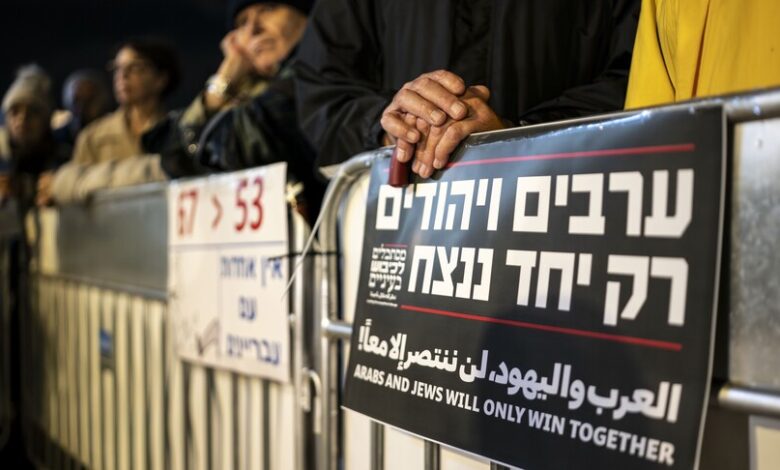
According to Haaretz, approximately 300 people gathered in the Merc Ibn Amir area of the Jezreel Valley to voice their demand for a coalition that incorporates Arab political parties. Simultaneously, The Times of Israel reported that hundreds of protesters assembled at Habima Square in central Tel Aviv. The Tel Aviv demonstrators carried banners with the text “67 seats… We are embarking on a new path” written in both Arabic and Hebrew. This specific reference to 67 seats likely alludes to the number of Knesset seats held by parties or blocs that the protesters believe should form the basis of a new, inclusive government.
The slogans chanted by the crowd reflected a clear political message: “There is no peace without partnership” and “The era of divide and rule must end, freedom and equality for all.” These demands stand in contrast to the current political landscape, where the formation of a government has been a central point of contention following the recent elections.
The protests also addressed specific legal and human rights concerns. Some demonstrators held signs calling for the release of journalist Abd Ebu Shehade, who was detained on suspicion of “contacting a foreign agent.” The detention follows his trip to Doha to conduct an interview with former Member of Knesset (MK) Azmi Bishara. The inclusion of this demand suggests that the protesters view the current legal actions against journalists and opposition figures as part of a broader strategy of political exclusion.
The “Standing Together” movement, a coalition of Jewish and Arab organizations that advocates for partnership and political equality in Israel, publicly supported the demonstrations in Tel Aviv. Their involvement underscores the cross-community nature of the protest, bringing together diverse groups united by the desire for a more representative political structure.
These public displays of dissent occur against the backdrop of formal constitutional processes. Israeli President Isaac Herzog has been conducting mandatory consultations with political parties to determine who will be given the mandate to form a government. According to reports, President Herzog has decided to grant the mandate to Gadi Eisenkot, the leader of the Yashar Party. This decision is a critical procedural step in the Israeli electoral system, which requires the President to identify a candidate who is most likely to command a majority in the Knesset and form a cabinet.
The political significance of the protests lies in their timing and their specific demands. By calling for a government that includes Arab parties, the demonstrators are challenging the traditional exclusion of Arab political parties from ruling coalitions, a practice that has been a source of tension in Israeli politics for decades. The reference to ending the “Netanyahu era” indicates that many protesters view the current leadership as incompatible with the values of equality and partnership they advocate for.
The response from the political establishment and the outcome of President Herzog’s consultations will be closely watched. If Gadi Eisenkot is unable to form a government that meets the demands of these protesters, or if the resulting coalition excludes Arab parties, the political instability may persist. The protests serve as a reminder that the mandate for government formation is not just a legal procedure but a reflection of the broader societal expectations for representation and justice.
As the government formation process moves forward, the success of the new cabinet will depend on its ability to address the concerns raised by the protesters. The inclusion of Arab parties, or at least a commitment to their political participation, could be a key factor in stabilizing the government and addressing the deep divisions within Israeli society. The next few weeks will be crucial in determining whether the political system can respond to these demands or if further unrest is likely.