Political Timing and Electoral Context
The strike was timed with considerable political precision. It took place just over two weeks before Spain’s general election, scheduled for November 29, 2026, and only two days before the official election campaign period begins. This proximity to the vote underscores the growing perception among voters and political actors that housing affordability is no longer a peripheral social issue, but a decisive factor in the upcoming electoral contest.
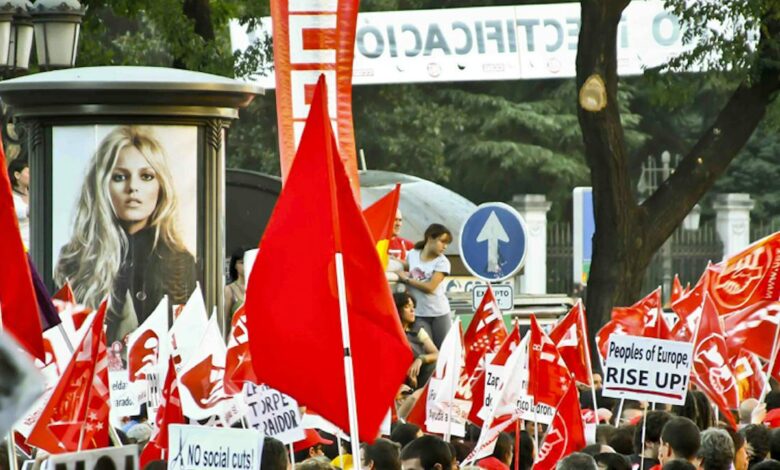
The decision to strike followed the rejection of housing-related decree-laws by the Congress of Deputies. UGT stated that the large-scale housing demonstrations held on the preceding weekend demonstrated the magnitude of public demand for government action. The unions argued that the legislative failure necessitated direct industrial action to force policy changes. The strike was backed not only by UGT and CCOO but also by other major labor organizations, including the General Workers’ Union (CGT), the Workers’ Union (CO.BAS), and Solidaridad Obrera. Regional unions, such as the CIG in Galicia and ELA and LAB in the Basque Country, also endorsed the action. Additionally, the Confederation of Tenants’ Unions, which coordinates local tenant organizations across Spain, formally endorsed the date of November 11, linking the labor movement with the broader tenant rights campaign.
Demands and Policy Proposals
Under the slogan “Wages, housing and prices,” the unions are demanding a coordinated approach to economic relief. Their core demands include pay rises ranging between 4% and 7%, the implementation of rent limits, and the establishment of a permanent stock of protected public housing. The unions explicitly link workers’ earnings to the escalating cost of renting and buying homes, arguing that current wage levels are insufficient to cover basic housing costs in major urban centers.
The broader platform proposed by UGT and CCOO includes salary-review clauses and measures intended to improve access to housing. The action is framed not merely as a labor dispute, but as a defense of the “right to housing and decent wages to pay for it.” This framing reflects a strategic alignment between labor unions and tenant groups, seeking to present a united front against market-driven housing policies.
Impact on Public Services and Daily Life
The general strike, which ran from midnight to midnight, caused significant disruption to public transport and essential services. In Madrid, scenes of near-empty platforms were reported at major hubs such as Atocha train station, where passengers navigated the chaos of reduced services. Although minimum-service arrangements were announced for transport, healthcare, and schools prior to the strike, coverage varied considerably by region and operator. Workers on shift patterns were permitted to begin or finish their strike action outside the standard midnight-to-midnight window, aligning their absence with their first and final shifts at their respective workplaces.
The disruption highlighted the tension between the right to strike and the continuity of essential public services. While minimum services were maintained in critical sectors such as healthcare, the partial nature of these arrangements led to complaints from citizens who relied on public transport and other daily services. The variation in service levels across different autonomous communities further complicated the national narrative, with some regions experiencing more severe disruptions than others.
Historical Significance and Institutional Context
This is the first general strike in Spain in 14 years, a period during which industrial action has been relatively subdued compared to the decades following the transition from Francoist dictatorship. The last comparable nationwide stoppage occurred in a different political and economic context, making the 2026 strike a notable development in Spanish political life. The strike’s focus on housing distinguishes it from previous industrial actions, which have traditionally centered on labor rights, pension reform, or broader economic austerity measures.
Academic analysis suggests that this shift reflects a broader transformation in Spanish society, where the housing crisis has become a defining feature of contemporary political life. The involvement of tenant unions alongside traditional labor federations indicates a coalition-building strategy that transcends traditional class boundaries, appealing to a wider demographic of renters and young workers who are particularly affected by high housing costs.
Consequences and Next Steps
The immediate consequence of the strike is the heightened visibility of housing policy in the lead-up to the November 29 election. Political parties are expected to intensify their campaigns on this issue, with housing affordability likely to become a central point of differentiation between competing platforms. The rejection of housing decree-laws by Congress has left a policy vacuum that the new government, elected in November, will be expected to address.
For the unions, the strike represents a test of their ability to influence public opinion and policy outcomes in a fragmented political landscape. The success of the action will be measured not only by the level of participation but also by whether it leads to tangible policy changes in the post-election government. The next formal step in this political process is the general election on November 29, where voters will have the opportunity to express their views on housing and economic policy through their ballot choices. The outcome of this election will determine which political forces are in a position to implement the housing reforms demanded by the unions and tenant groups.