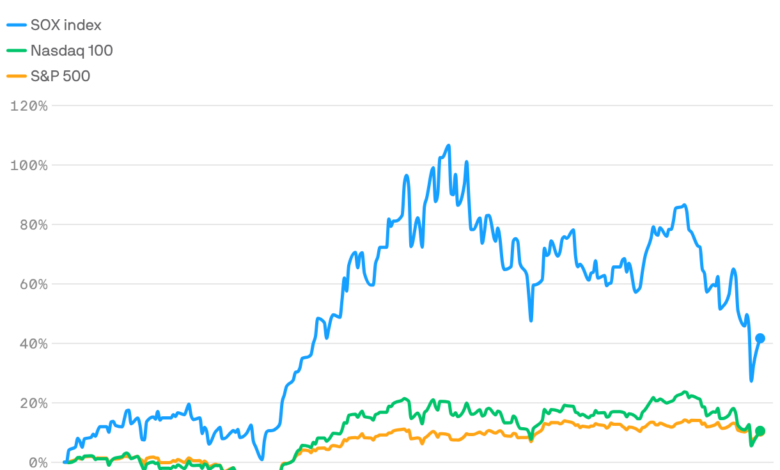
The immediate financial impact has been pronounced. Nvidia shares fell 4.3% in recent trading and have lost more than 20% of their value over the past month. However, the broader artificial intelligence sector has seen a sharp rebound, with the Nasdaq 100 index surging 3.4%, its largest daily jump since late March. Investors appear to be rotating funds away from Nvidia and toward competitors, with Advanced Micro Devices (AMD) shares soaring 13.3% and Broadcom jumping 8.8%. Analysts from Goldman Sachs, Morgan Stanley, and JPMorgan have characterized the recent tech sector slump as an oversold opportunity, suggesting the market’s reaction to the scandal and recent midterm election outcomes may be overdone.
Geopolitical implications extend to South Korea, where officials are concerned that the scandal could disrupt global AI supply chains. The close relationship between Huang and South Korean tech leaders, including Samsung’s Lee Jae-yong and SK Group’s Chey Tae-won, has played a crucial role in regional semiconductor cooperation. There are growing fears that the incident could trigger tighter U.S. export controls on Seoul’s semiconductor champions, further complicating the already sensitive landscape of chip technology.
Huang’s recent public commentary on China adds context to the board’s concerns. On November 5, 2025, Huang stated that “China is going to win the AI race,” citing lower energy costs and lighter regulation in the region. He previously criticized U.S. export controls as a failure that pushed customers toward local alternatives, noting in May 2025 that China’s AI-chip market could reach $50 billion within two to three years. In October 2026, Huang admitted that U.S. limits on chip sales to China were a mistake, though he described China as a competitor rather than an enemy. According to Motley Fool, customers headquartered in China, including Hong Kong, accounted for approximately 8% of Nvidia’s prior-quarter revenue, or about $7.9 billion.
This incident follows a complex timeline of U.S.-China chip negotiations. In December 2025, President Trump indicated that the Commerce Department would allow Nvidia to ship advanced chips to approved Chinese customers in exchange for a 25% revenue cut. Subsequently, sales to about 10 Chinese companies were reportedly approved during Trump’s Beijing trip in May 2026. The board’s independent review will determine if Huang’s actions constitute a conflict of interest, a decision that could influence future oversight of tech CEOs and the stability of the global AI infrastructure.