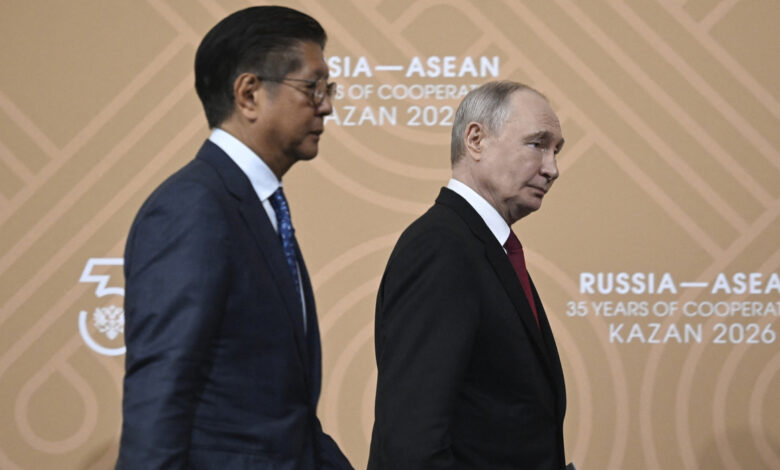
The ASEAN-Russia Commemorative Summit, held June 17–18, marked the 35th anniversary of dialogue relations and the 30th anniversary of formal partnership between the two sides. The turnout was notable, with nine of the eleven ASEAN heads of state present, alongside the Indonesian foreign minister and a special representative from Myanmar. This collective diplomatic gesture occurred at a pivotal moment in the reconfiguration of global geopolitics. The timing was particularly symbolic, as the summit partially overlapped with the Group of Seven (G7) meeting in France, where Japan and other industrialized Western powers reaffirmed efforts to isolate Moscow. While the West gathered in Europe, Southeast Asian leaders traveled to Russia, reflecting a growing reality of a multipolar world no longer dictated by one or two traditional centers of power.
The primary driver for this high-level engagement was economic necessity. U.S. President Donald Trump’s war against Iran has created major problems for Southeast Asian countries, forcing them to seek alternative sources for hydrocarbons and fertilizer. Aside from Brunei, all ASEAN members import energy, and most do not hold the ninety-day reserves typical of Organisation for Economic Co-operation and Development (OECD) states. With the risk of hostilities between Iran and the United States restarting remaining high even if a ceasefire is reached, ASEAN nations have found it imperative to secure deals with alternative suppliers, including Russia. Moscow, in turn, views these countries as a critical market for its exports, which include not only oil, gas, and fertilizers but also weapons and nuclear power equipment.
For the Kremlin, this summit represents a strategic necessity. Facing growing economic problems and a lack of progress on the battlefield in Ukraine, Moscow is rapidly building trade, technological, and financial ties with the Global South to sustain its confrontation with the West. In recent years, Russia’s reliance on China has deepened to the point where the Kremlin is beginning to worry about its dependency. Consequently, Southeast Asia, with its growing economies and huge demand for raw materials, has become a desirable partner. Putin’s acceptance of two elephants as a gift from Laos Prime Minister Sonexay Siphandone during the summit served as a light-hearted but potent symbol of this deepening engagement, as he assured the leader that the animals would be kept in the best conditions.
However, the summit also highlights a broader shift in regional security architecture. Over the past decade, ASEAN has pursued a deliberate strategy in the South China Sea to “institutionalise” regional conflicts before they are completely taken over by raw power politics. Southeast Asian countries, lacking the military power to counterbalance China, have increasingly adopted multilateralism, legal frameworks, and external cooperation to maintain strategic space. This approach was evident in recent ASEAN summits, where member states advanced cooperation programmes on maritime affairs and reiterated the importance of the United Nations Convention on the Law of the Sea (UNCLOS).
The arrival of Donald Trump in Beijing for a summit with Xi Jinping days after these ASEAN meetings underscored a different political logic. Trump’s visit, accompanied by influential corporate figures, focused heavily on agricultural purchases, energy deals, Boeing orders, and technology supply-chain issues. The possibility of deferring part of a major U.S. arms deal to Taiwan further fueled a growing belief in the region that the U.S. administration may have a less long-term perspective toward Asia, responding more to domestic political pressures than to long-term strategic interests.

This unpredictability has pushed ASEAN nations to hedge their strategic bets. The region is deepening ties with various external security actors, including strengthening defence ties with Japan, while maintaining economic dependence on China. The goal is not to defeat China or fully align with Washington, but to prevent Southeast Asia from becoming negotiable terrain between major powers. By engaging with Russia in Kazan, ASEAN leaders are demonstrating a pragmatic diplomacy that prioritizes energy security and economic diversification in a world where the assumption that major-power competition preserves regional relevance is being tested.
As the leaders of these 700 million people continue to navigate this complex landscape, the Kazan summit stands as a testament to the fluidity of the new world order. The immediate consequence is a strengthened economic pipeline between Moscow and the Global South. The longer-term tension remains unresolved: how Southeast Asian states will manage their strategic space when the major powers they seek to balance are increasingly focused on short-term bilateral deals rather than multilateral stability. The next phase of this dynamic will likely be defined by the durability of these new trade ties and the continued volatility of the U.S.-Iran conflict, which remains the underlying catalyst for this geopolitical realignment.