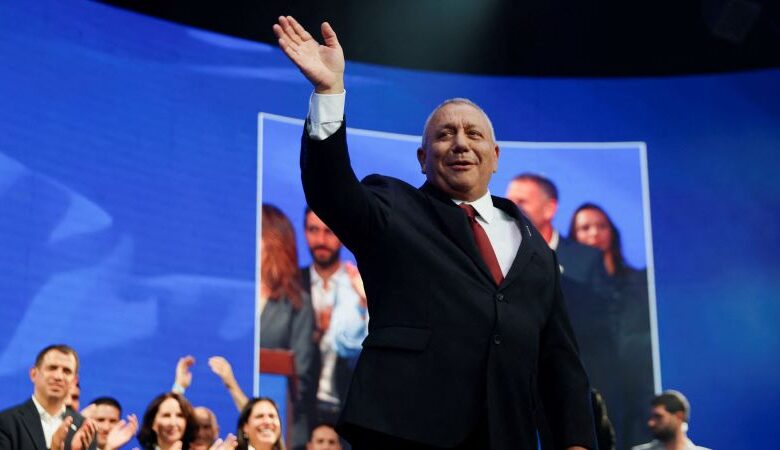
The presidential decision was based on the results of Herzog’s consultations with delegations from the incoming Knesset. According to the statement, factions totaling 67 members of the 120-seat parliament backed Eisenkot, while 46 supported Netanyahu. This numerical advantage, however, does not equate to a guaranteed governing coalition. In a notable development during the consultations, United Torah Judaism, a traditional ally of Netanyahu, declined to recommend him, exposing a crack in his previously loyal bloc. Conversely, Eisenkot’s tally included support from the two Arab-led parties, the United Arab List and the Joint List, which together secured a record 19 seats in the recent election. Despite this support, all but one of the Jewish parties in Eisenkot’s bloc had pledged before the polls not to work with Arab parties to form a government, creating a complex dynamic where the Arab parties may serve as “kingmakers” from outside the cabinet rather than as cabinet members.
The political landscape following the October 27 elections is defined by a stalemate. Neither the right-wing bloc led by Netanyahu’s Likud party nor the opposition bloc led by Eisenkot secured a majority. Netanyahu’s camp finished with 53 seats, while the opposition, comprising Yashar, Together, Yisrael Beiteinu, and the Democrats, ended with 48. Likud remained the largest single party with 27 seats. Under Israeli law, the president has broad discretion to select the candidate they believe has the best chance of building a coalition and is not obligated to choose the leader of the largest party. Herzog stated that to prevent another round of elections and build a stable government, he expected factions to understand the necessity of compromise.

Eisenkot’s path to power is fraught with internal divisions and strategic obstacles. He has vowed to “do everything” to form a “national emergency government,” aiming to swear in a minority administration as soon as possible. This proposed government would comprise the four Jewish opposition parties, which together hold 48 seats. Eisenkot has set four conditions for participation: recognizing Israel as a Jewish, democratic, liberal, and egalitarian state; commitment to the values of the Declaration of Independence; universal service (military, national, or civilian); and the recognition of Hamas as a terrorist organization. The final condition effectively rules out Arab parties from sitting in the Cabinet, though they could still support the government from outside, providing the parliamentary safety net required to maintain a simple majority.
The central obstacle for Eisenkot is Avigdor Liberman, leader of Yisrael Beiteinu. Liberman has ruled out any government dependent on the Arab parties, arguing that a minority government would be short-lived and, in the long run, would only strengthen Netanyahu. He warned that such a fragile arrangement could lead to Netanyahu returning with 70 seats for another four years. Israeli law requires only a simple majority to establish a government, but removing one is far more difficult, requiring an absolute majority of 61 votes to support an alternative government. This legal threshold highlights the precariousness of Eisenkot’s position; if he fails to form a government within his allotted time, the president can extend the deadline by up to 14 days. If that fails, a second leader may be given a chance, and if all attempts fail, another election is called.
The situation recalls the 2020 power-sharing deal between Netanyahu and Benny Gantz, which emerged after three deadlocked elections. At that time, the two rivals agreed to rotate leadership, establishing a precedent for a national unity administration. However, the current political arithmetic presents three distinct options: a unity government involving both Netanyahu and Eisenkot, a right-wing coalition involving Netanyahu and defectors from the opposition, or an Eisenkot-led government supported by the Arab parties. While Eisenkot and his bloc have largely refused to enter a government with Arab parties, speculation remains that an agreement could be reached to secure the necessary votes. The coming weeks will determine whether Eisenkot can navigate these divisions to form a stable administration or if Israel faces a return to the ballot box.