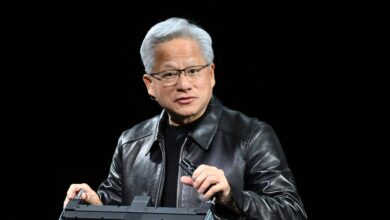
The technological and commercial implications of this personal disclosure are profound. Since founding Nvidia 33 years ago, Huang has positioned himself not merely as a corporate leader, but as the indispensable architect of the AI economy. With a market capitalization approaching $5 trillion, Nvidia is the primary supplier of the GPUs—graphics processing units specialized for parallel calculation—that power the data centers of giants like Microsoft, OpenAI, and Google. Huang has frequently served as a stabilizing force for global markets, using his influence to calm fears of an AI speculative bubble and to reassure investors of sustainable demand. Analysts note that the company is uniquely “founder-driven,” with Huang maintaining more than 60 direct reports and eschewing traditional corporate layers. As Dan Gallagher, an analyst with Washington Post Intelligence, noted, it is “very hard to envision Nvidia run by anybody else,” and there is little precedent for valuing the company without his specific leadership and public credibility.
At the center of the scrutiny is Megaspeed, a Singapore-based cloud computing company that advertises itself as a “core business partner” for Nvidia’s computing power cloud business in the Asia-Pacific region. Megaspeed provides large-scale computing capacity to regional clients, often for AI projects, by renting access to Nvidia GPUs hosted in Southeast Asia. This model allows businesses to perform costly AI operations without owning the hardware and, critically, can provide remote access to advanced chips located outside China. However, the company has previously faced media and government scrutiny over whether some of its GPUs were being redirected to China, a destination subject to strict U.S. export controls on certain advanced semiconductor technology. U.S. intelligence officials believe Alice Huang was leveraged by Beijing to gather intelligence on Nvidia’s efforts to expand chip sales and to potentially circumvent these regulatory barriers.
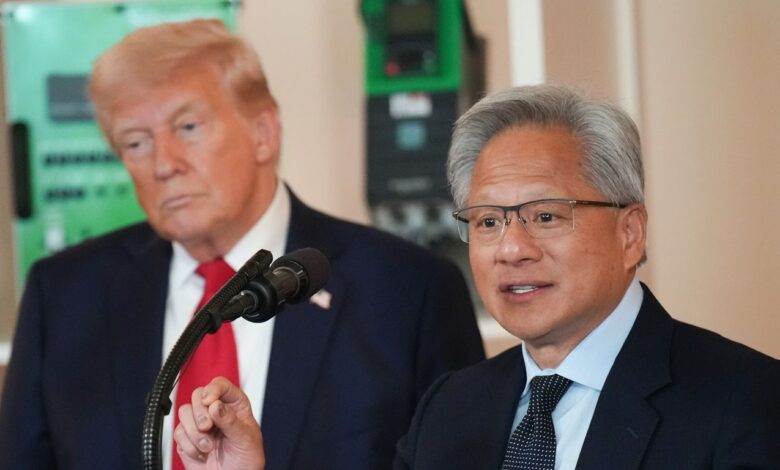
Nvidia’s response has been a careful balancing act between legal prudence and reassurance. In a statement, the company said Huang “has been the target of a foreign intelligence effort” and that the board’s inquiry, led by independent board members and an external law firm, would “examine all available information.” Crucially, the board stated it had “no reason to believe that either national security or NVIDIA secrets were compromised.” Huang, who intends to remain CEO during the investigation, pledged full cooperation, stating in his letter: “I love our country and our company. I am committed to protecting NVIDIA and supporting America’s national security.” President Donald Trump, who has a close relationship with Huang, publicly defended the CEO on Sunday evening, calling him “an honorable guy” and suggesting he “probably has an excuse,” though he hedged on whether Huang should remain a White House adviser if further evidence emerges.
The incident has already rippled through financial markets, with Nvidia’s shares falling in early trading on Monday. The vulnerability extends beyond the company itself to the broader AI ecosystem. Companies like Anthropic and OpenAI, which rely heavily on Nvidia’s hardware and Huang’s ability to secure financing and customer confidence, now face increased uncertainty. While Anthropic, for instance, is diversifying by using chips from Google and Amazon and planning an IPO, the industry’s reliance on Nvidia’s specific ecosystem remains high. Huang has historically offered financial backstops to shore up growth plans for customers such as CoreWeave, and his ability to continue this role is now under question. The “too big to fail” nature of Nvidia’s executive leadership means that any forced transition could be perilous for an industry currently navigating a trillion-dollar infrastructure buildout.

Underlying the scandal are persistent questions about the integrity of the global AI supply chain. The alleged espionage operation highlights the tension between U.S. export controls and the commercial reality of remote access to computing power. If advanced chips can be accessed remotely from Southeast Asia, the physical location of the hardware becomes less decisive than the identity of the user and the data flowing through the system. U.S. officials had reportedly drafted a memo regarding the allegations before Trump’s May summit with Xi Jinping, indicating that the intelligence community viewed this as a significant national security concern long before it became a public corporate crisis. Tim Culpan, an Asia tech reporter who has covered Nvidia extensively, noted that while Nvidia’s fundamental strengths in chip design remain intact, the personal damage to Huang’s reputation is significant. The company is still expected to produce high-performance chips, but the trust required to operate at the apex of the AI race has been fractured.
As the independent board inquiry proceeds, the focus remains on whether any proprietary technology or strategic intelligence was exfiltrated. The narrative has shifted from a simple corporate governance issue to a matter of national security and geopolitical stability. For now, the market waits to see if the “indispensable” leader can survive the investigation, or if the AI boom must begin to prepare for a future without the singular voice that has kept it steady.