
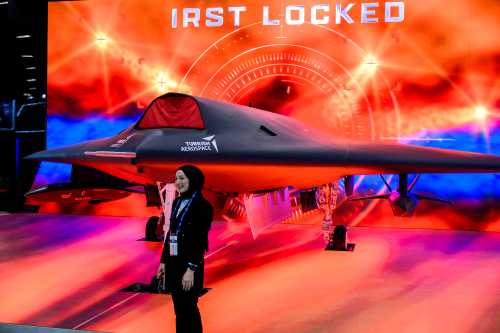
These restrictions have forced Turkish defense primes to invest heavily in indigenous technologies, aiming to remove U.S.-origin components from their supply chains. The result has been a surge in domestic production and exports, particularly in low-cost, high-volume systems. Turkey has become a leading global player in artillery shell production, utilizing an innovative process to manufacture 155mm shells that are in high demand in both the United States and Europe. Simultaneously, drone manufacturer Baykar has established a dominant position in the global export market with its TB2 unmanned aerial vehicle, often sold as part of a complete weapon system that includes missiles from partners like Roketsan.
Despite this success, Turkish leaders argue that U.S. export controls have hindered the sale of other platforms, including certain attack helicopters and the TB2 drone to specific customers. While media narratives suggest Turkey is poised to compete aggressively for European contracts amidst increased defense spending following the Russian invasion of Ukraine, analysts indicate this is unlikely in the near future. Instead, Ankara is pivoting toward new markets. A trilateral defense pact, signed on August 7 between Saudi Arabia, Turkey, and Pakistan, known as the “Mecca Pact,” is expected to facilitate this shift. The agreement includes a collective defense clause, stipulating that an armed attack on one state is regarded as an attack on all three, and aims to strengthen collective deterrence.
Analysts describe the pact as much broader than a simple arms-export agreement. Ali Bakir, a defense analyst at Qatar University, stated that the pact aims to facilitate joint investment, technology transfer, local production, and research and development. “It aims to facilitate joint investment in defense industries, major defense projects, technology transfer, local production, research and development, training, and the integration of complementary capabilities,” Bakir said. Serhat Süha Çubukçuoğlu, director of the Turkey program at TRENDS Research & Advisory, noted that Saudi Arabia seeks to build domestic manufacturing and engineering capacity under its Vision 2030 initiative. He added that Turkey is well-positioned to support this goal by offering combat-tested systems with fewer political restrictions and more flexible localization arrangements than traditional Western suppliers.
The pact is expected to boost arms sales from Ankara to Riyadh specifically, while integrating the defense industries of all three nations into a tighter “ecosystem.” Albert Vidal, a research analyst at the International Institute for Strategic Studies, noted that the agreement could provide a nudge for Turkish companies trying to penetrate the Saudi market, where progress had been slow beyond the 2023 Akinci unmanned combat aerial vehicle deal. Experts point to potential transfers of air defense systems and the indigenous fifth-generation KAAN fighter jet. For Turkey, the pact may help offset the impact of U.S. restrictions by providing a deeper, institutionalized defense ecosystem with Saudi Arabia and Pakistan, enhancing collective strategic autonomy and deterrence. The Turkish parliament must still ratify the accord for Turkey to officially join the pact, a step analysts consider unlikely to be blocked.