Her words encapsulate the central tension France is navigating as it marks the tenth anniversary of the November 13, 2015, coordinated assaults. That night, gunmen linked to the Islamic State group and suicide bombers turned the French capital into a theater of blood and calamity, targeting a soccer match, neighborhood cafés, and a rock concert. The attacks killed 132 people, including two survivors who later died by suicide, and wounded hundreds more. Many in France and abroad have described the events as the country’s 9/11, a watershed moment that hardened security reflexes and deepened a sense of solidarity that, according to families, has endured a decade later.
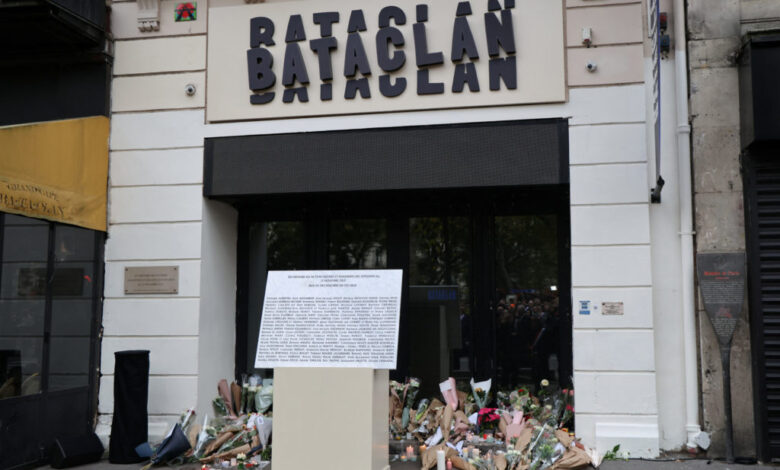
President Emmanuel Macron and First Lady Brigitte Macron were present at the Stade de France for a wreath-laying ceremony and a minute of silent remembrance, alongside Paris Mayor Anne Hidalgo. Macron, who wrote earlier on X that “Ten years. The pain remains,” traveled through the city in sequence, visiting each attack site to lay flowers and honor the victims. The itinerary took him from Saint-Denis to the Carillon and Petit Cambodge cafés in the 10th arrondissement, then to La Bonne Bière, Le Comptoir Voltaire, and La Belle Équipe in the 11th, before concluding at the Bataclan concert hall, where 90 people were killed during a three-hour siege. In a protocol described by the presidency as “families first,” victims’ relatives were placed closest to the commemorative plaques at each location, a gesture intended to center the human cost over political ceremony.
The Bataclan remains the most visceral site of the tragedy. Arthur Dénouveaux, a survivor who was among the roughly 1,500 people inside the hall when the gunmen opened fire, recalls the night not as a blur, but as a series of fragmented, high-definition images. He remembers the muzzle flash from the Kalashnikovs, the crowd scrambling, and a young girl staring in confusion before being pulled to the floor. “Finding myself under the night sky in Paris,” Dénouveaux says, “and saying to myself, ‘Hey, I’m free again.'” Dénouveaux now serves as the president of Life for Paris, a support group for victims, which he says plans to disband after the 10th anniversary, signaling a potential shift in how the community processes the trauma.
While the rituals of remembrance have become an extensive system of plaques, memorials, and documentaries, the psychological and historical implications of the attacks are still being unpacked. A decade ago, the immediate response was one of shock and unity; today, the challenge is how to live with the memory without being defined by it. New research indicates that the specific details of the night are already fading from collective memory, prompting historians like Denis Peschanski to study how different individuals recover from post-traumatic stress disorder. For some, like Paris resident Anaelle Baheux, who lives steps away from one of the attacked cafés, the public rituals remain essential. “It’s reassuring to see that people didn’t forget what happened,” she says, highlighting the role of public remembrance in validating personal grief.
The legal aftermath of the attacks has also reached a conclusion, with a landmark 10-month terrorism trial ending in 2022 with the conviction of 20 men, including the only surviving member of the group that carried out the attacks. This judicial closure contrasts sharply with the emotional state of the victims’ families, who continue to seek understanding rather than just accountability. The attacks have fundamentally altered the urban landscape of Paris, not just through the physical scars on the buildings, but through the invisible network of memory that connects the Stade de France to the Bataclan. As the day of tributes concluded, the silence that fell over the boulevard outside the Bataclan served as a reminder that while time has passed, the narrative of that night is far from over. The question for France is no longer how to remember the event, but how to integrate it into the national identity without allowing the pain to calcify into a permanent state of fear.