The election, held on Saturday, produced no clear winner. According to initial data with over 99% of standard votes counted, the center-right National Party won 42 seats, falling 19 seats short of the simple majority required to form a government independently. Combined with its coalition partners, the pro-business ACT Party (13 seats) and the right-wing populist New Zealand First (12 seats), the right-leaning grouping is projected to hold 67 seats. This constitutes a slim majority in a parliament that has expanded to 131 seats due to an “overhang” of additional members elected under the country’s mixed-member proportional (MMP) system.
On the other side, the opposition bloc, comprising the center-left Labour Party (36 seats), the leftist Greens (16 seats), and the indigenous party Te Pāti Māori (5 seats), is projected to hold 57 seats. However, this bloc could gain a pathway to power if it secures additional seats in the final count and wins the support of the centrist Opportunity Party.
The primary variable in this deadlock is the Opportunity Party, led by millennial political newcomer Qiulae Wong. The party, which positions itself as both business- and climate-friendly, is projected to win seven seats, crossing the 5% threshold to enter parliament for the first time since its founding in 2017. This would make the Opportunity Party the first total outsider party to enter the New Zealand parliament in three decades. Professor Andrew Geddis, an election law expert at the University of Otago, described the party as a “wildcard player” that could “determine which bloc of parliaments” forms the next government.
The uncertainty stems from nearly 400,000 “special votes” that have yet to be counted. These include ballots cast by New Zealanders living overseas and others under special circumstances. The Electoral Commission is scheduled to deliver the final official results on November 27. Historically, these special votes have tended to benefit left-leaning parties, potentially shifting the preliminary results in Labour’s favor over the coming three weeks.
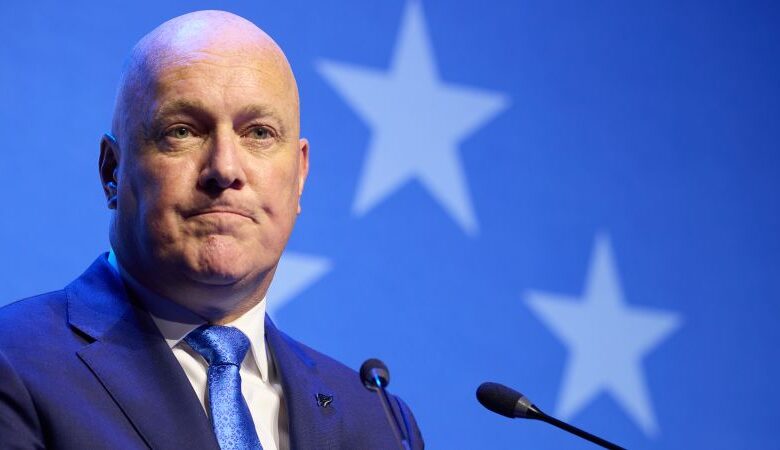
Prime Minister Luxon addressed supporters in Auckland, acknowledging that while his party appeared to have a pathway to form the next government, the race remained “too close to call.” He stated that the country must wait for the Electoral Commission’s final tally before certainty can be established. In a notable shift in tone, Luxon, who had previously ruled out cooperating with the Opportunity Party, adopted a conciliatory stance on Sunday morning. “I actually do want to build a relationship with her as the leader and also with her party, and try and find common ground,” Luxon said, congratulating Wong on the party’s historic achievement.
Labour Leader Chris Hipkins, addressing supporters in Wellington, made light of the inconclusive results. “Tonight, New Zealand has spoken. It may take us a little bit longer to figure out exactly what it is that you’ve said,” Hipkins said. He emphasized that the next parliament would require all parties to compromise and work together, noting that the “shape of the next government” would remain uncertain for a while. Luxon confirmed he would run a caretaker government until the final results were confirmed, adding that meaningful negotiations could only begin once the official count was complete.
The election result reflects significant public discontent with the incumbent government’s handling of high gas prices, stubbornly high unemployment rates, and healthcare issues. An unusual dynamic emerged as swing voters abandoned the traditionally dominant National and Labour parties, opting instead to support minor parties across the political spectrum. Preliminary data indicates that National and Labour combined secured only around 60% of the vote, marking historically low support for the two major parties.
With the final count pending, the political focus now turns to the coalition negotiations that may follow. If the right-wing bloc fails to hold on to its slim majority, the Opportunity Party’s seven seats will be pivotal. Wong stated that her party would work with either side but indicated they would negotiate first with the party that secures the most seats. The next formal step in the process is the release of the official results by the Electoral Commission on November 27, which will determine whether the current coalition retains its mandate or if a new government must be formed through extended negotiations.